

“Joseph Ratzinger never wanted to build his own system of thought or establish his own school but taught us to seek the truth with the power of reason and the light of faith, always keeping reason ‘open,’ in dialogue between people, disciplines, and the great religious traditions,” Lombardi said.
The pope “was well aware of the possibilities and risks of humanity’s journey, as well as of the Church’s mission for its salvation. He leads us to enter with humility and courage at the deepest level to find and rediscover points of reference and solid and inalienable communities,” Lombardi continued.
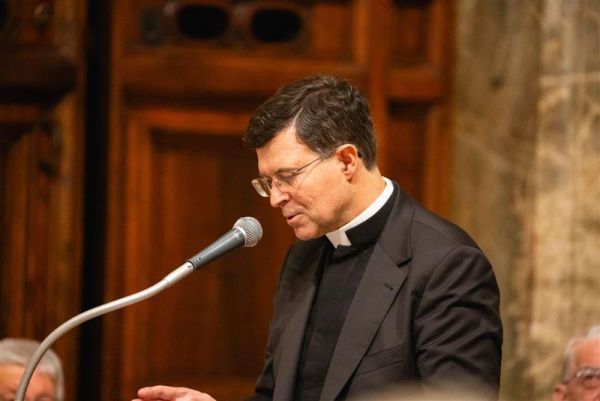
The Joseph Ratzinger-Benedict XVI Vatican Foundation, established in 2007, aims at “the promotion of theology in the spirit of Joseph Ratzinger.” There have been a total of 28 recipients of the award — usually two recipients per year — since it was first bestowed in 2011.
The recipients this week were introduced by Cardinals Gianfranco Ravasi and Luis Francisco Ladaria Ferrer, with each reflecting on their work on Benedict’s theology.
“Ratzinger defined Christianity as the religion of the words but also the religion of ‘agape’ and, therefore, both are key,” Torralba said in an interview with EWTN. “We have to introduce rationality in our public life because it is very marked by emotionalism and sometimes by fanaticism and fundamentalism, but on the other hand, the world needs agape and agape is donation, it is gratuitous love.”