

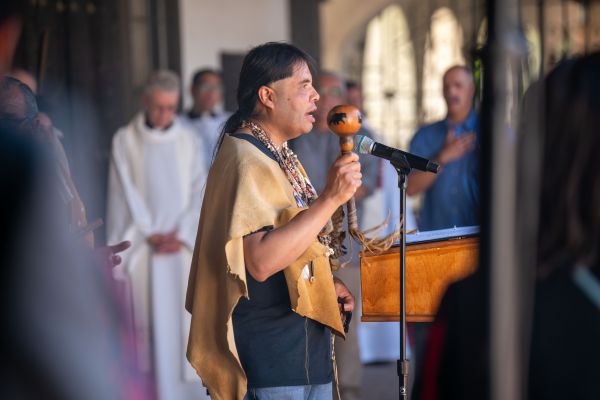
Adela Garcia, a Gabrieleño tribe member, grew up coming to the mission with her family. She told Angelus News that seeing the restored mission “brings me happiness” after seeing it nearly destroyed.
“There is going to be a lot of healing here,” she said.
The archbishop of Los Angeles reflected on their songs in his essay.
“The ceremony was built around their prayers, rituals, and sacred music, all in their native tongue,” Gomez said. He cited a “moving” line from one song: “O my ancestors, listen to my heart / O my ancestors, here is my heart.”
“These words remind us that our faith is never a solitary journey,” Gomez said. “We owe the gift of faith to our ancestors, to those who have gone before us, that great cloud of witnesses down through the ages who professed the Catholic faith and proclaimed it.”
“The missionaries came to this country with that noble intention, to share what they believed was the greatest gift they could ever give, the gift of knowing Jesus Christ and his love and salvation,” the archbishop added.
“As I walked the mission campus, I felt the strong sense that I was on holy ground, walking among the souls of the 5,000 Natives who are buried here, proud sons and daughters of this land’s ancient peoples who had met Jesus Christ and decided to make him the way and the truth for their lives.”
Gomez noted that the mission’s baptistry still has the original baptismal font used by St. Junipero Serra and other Franciscans. The museum also has the confessional believed to have been used by Serra as well as masterpiece paintings from the Spanish colonial era.
Before the fire, much of the artwork in the church had been removed as part of an ongoing restoration. A historic painting of Our Lady of Sorrows, depicting the Virgin Mary in a somber, dark landscape, was the only piece of artwork remaining in the church that survived the fire.
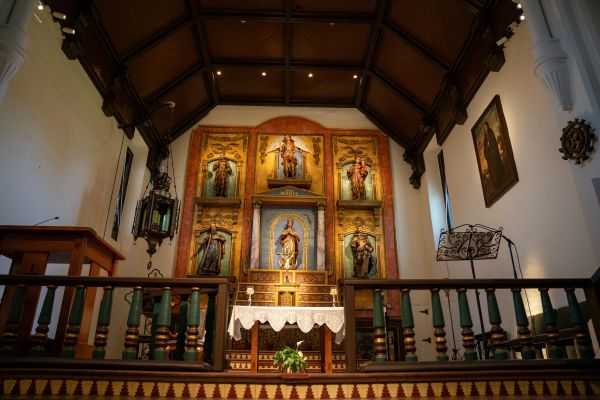
(Story continues below)
The museum has also been renovated to emphasize Native American perspectives.
Steven Hackel, a history professor at the University of California-Riverside, served as a curator on the renovation with Yve Chavez, a member of the Gabrieleño Tongva. The visual, audio, and interactive exhibits aim “to suggest the varieties of Catholic experience at the mission and the persistence of Native belief and practice within an expanding Spanish and Mexican realm,” Hackel said in remarks at the outdoor ceremony, according to Angelus News.
Museum visitors with smartphones can listen to historical audio recordings, including a rare recording of the Our Father in the Gabrieleño language.
Despite St. Junipero Serra’s record defending indigenous peoples, images of the saint have become focal points for protests and demonstrations across California by those who regard him as a symbol of colonization and Spanish abuses of the indigenous people, including their enslavement.
In 2020, in the wake of protests spurred by the murder of Minneapolis man George Floyd, numerous statues of the saint were torn down or vandalized by protestors.
Some California institutions, such as the University of San Diego, have put their statues of Serra in storage to protect them. Mission San Gabriel had put its images of Serra, including a bronze statue, into storage for this reason not long before the fire.