

In Israel, according to the latest data from the Ministry of Health, 46% of health care personnel are Arab — more than double the percentage of Arabs in the total population. Hospitals and health care centers are places where the coexistence of the two main groups of Israeli society is most pronounced. This is even more true in “mixed cities“ like Haifa, where Arabs and Jews are in close contact every day.
“Since the war began, some of my colleagues look at me with suspicion, and sometimes I hear comments that hurt me as a person,” Abu Sini said. “But these are isolated cases — often they are people who have lost a family member or acquaintance and are overwhelmed by anger.”
Abu Sini has patients from Gaza and the West Bank whom he hasn’t seen since the war began because all agreements have been suspended. These agreements between Israel and the Palestinian Authority allow patients to cross into Israel to receive health care, but this has now been suspended due to the state of war.
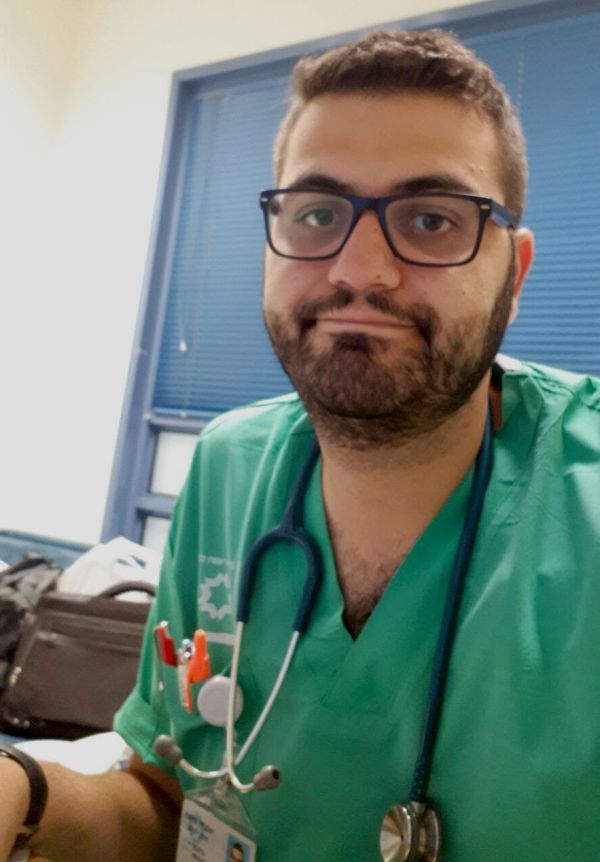
Abu Sini describes his recent return to work: “At first, it wasn’t easy. I had already planned to focus solely on studying, without interference … Then my patients made me realize how important it was that their doctor was there for them. As an oncologist, this is how I bring peace,” he told CNA.
“In my field, in addition to medical therapy, psychological therapy is also very important. I chose to become an oncologist also for this reason. With the war, I see that cancer patients lose confidence — ‘I will die anyway, why should I fight?’ Being there for them and helping them understand that their life matters makes a difference. I almost got angry with myself because in the first few days, I only thought of myself without considering my duty. Since then, I have realized that my presence is important here, for them and for me.”
Abu Sini was 11 years old during the second Intifada (a major Palestinian uprising in the Palestinian territories and Israel), and in 2006 he witnessed the second war between Israel and Lebanon. A rocket fell in Nazareth, the neighborhood where he lived at the time.
“The fear we have now is not even comparable to that… It’s something new, never seen before. And it’s also new because now I am a father, while before I wasn’t… Even my self-awareness has changed.”
Abu Sini said that every day when he says goodbye to his wife and children and leaves home, “I cannot help but think about what could happen while I am not with them. I rely on the presence of Christ among us. All the drama of living remains, the fear, the beating heart, but with Christ, life itself is more meaningful — even when things are not going well.”

Born and raised in Italy, Marinella Bandini has been a professional journalist since 2008. She works for several news agencies and online newspapers in the Catholic space. Currently based in Jerusalem, she collaborates with the Custody of the Holy Land.