

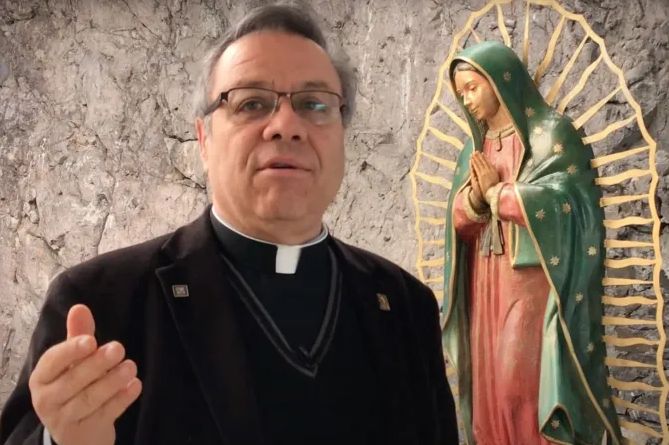
The Virgin of Guadalupe appeared to the Aztec Indian St. Juan Diego on Tepeyac Hill Dec. 9–12, 1531, expressing her wish that a Catholic church be built on the flat area at the foot of the hill.
Juan Diego then went to see the first bishop of Mexico, Franciscan Friar Juan de Zumárraga, to present Our Lady’s request. As proof of the veracity of the apparitions, the Indian brought the flowers Our Lady told him to cut from a non-native rose bush miraculously growing out of season on Tepeyac Hill.
To carry the flowers, Juan Diego folded his tilma or cloak over them. When he opened the tilma to present the flowers to the bishop, those present saw that the image of the Virgin of Guadalupe miraculously appeared on the cloth.
The tilma of St. Juan Diego is currently preserved in the Guadalupe Basilica, situated at the foot of Tepeyac Hill in Mexico City.
Since 1978, Chávez has been immersed in the study and dissemination of the message of the Virgin of Guadalupe, playing an important role in the beatification process (1990) and the subsequent canonization of St. Juan Diego (2002).
The priest was also one of the founders of the Higher Institute of Guadalupan Studies in 2003, together with Cardinal Norberto Rivera Carrera, then primatial archbishop of Mexico, and the late Monsignor José Luis Guerrero, who was the vice postulator of the cause of canonization of St. Juan Diego. The ISEG, created from research and studies approved by the Holy See, has become the main center to continue the study of the Guadalupan event.