
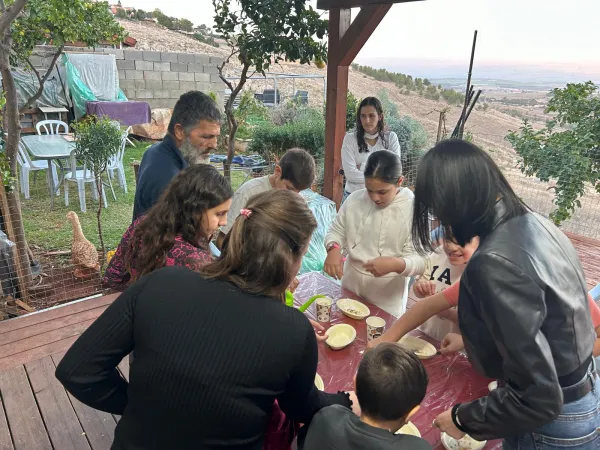
Noura visits the sick, families in difficulty, and those evacuated from high-risk areas who are now living in hotels (about 800 people), and he teaches catechism to children.
“Only with Christ,” he said “even in the midst of war, there is hope; in the midst of death, there is resurrection.”
He brings to his faithful the message of God’s love for humanity, the same love that changed his life as a teenager.
“I was 13 years old when, from one day to the next, we fled from Lebanon and came to Israel,” along with thousands of people, he told CNA. All of them were considered traitors because they belonged to the pro-Israeli militia called the South Lebanon Army, like Noura’s father, or had relations and contacts with Israelis.
“I wondered: why did all this happen to me? I’m just a child. I wanted to escape from this world; I had lost trust in everyone, even myself.” Then came an encounter with the Neocatechumenal Way, a Catholic community, and the message that “God exists and loves me as I am. It was the answer I was looking for. It restored my hope.”
For this reason, he continued, “In the face of this war, we want to choose the good, that is, Christ. Jesus said, ‘love your enemies.’ Choosing Christ is choosing love, to love everyone.”
Habib, the parish priest of Jish agrees: “The key word in Christianity is love: love God and every human being, even the enemies.” This is the guiding light for him.
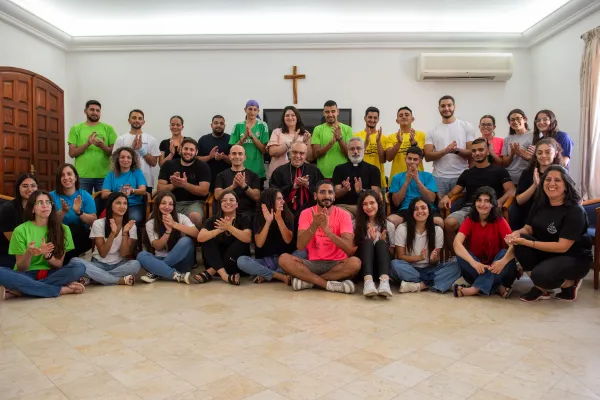
CNA met Habib in Jerusalem, along with a group of 30 young people from the Apostolic Movement, a group that was founded 25 years ago in the parish of Jish with the aim of “bringing ourselves closer to Jesus,” Habib explained. “We try to achieve this through spiritual activities, social activities like trips, and by announcing Jesus Christ.”
The group was organizing a summer camp for children and adolescents scheduled for the first half of August. Last year, there were about 300 participants, and the same number is expected this year, despite the current situation.
(Story continues below)
Subscribe to our daily newsletter
“The first months of the war,” he recounted, “we had to stop all the celebrations inside the church, which is on the second level of the parish building and move everything downstairs. We also stopped almost all activities, especially with the children. We used to hear very loud artillery and sirens from time to time. This caused some panic.”
Since mid-February, the community has returned to the church and restarted the activities in the parish. “Jish is not really targeted, even though we have to take all the precautions. Life is semi-normal… until you hear the sirens or the heavy artillery.”
Habib tries to teach the youngest children “the importance of holding on to our faith, to trust in Jesus, who is the only one who can bring real peace in our hearts and in the hearts of everyone.”
“We pray for everyone because every human being is created in the image of God,” he underlined. “God, who is love, loves every human being, and He wants us to love as He loves.”
Father Mehri covers the last kilometers separating him from Deir Mimas as quickly as possible. Israeli drones could mistake him for a Hezbollah militia member and strike him. For this reason, he never stays beyond 3 p.m.; it’s safer to return in daylight.