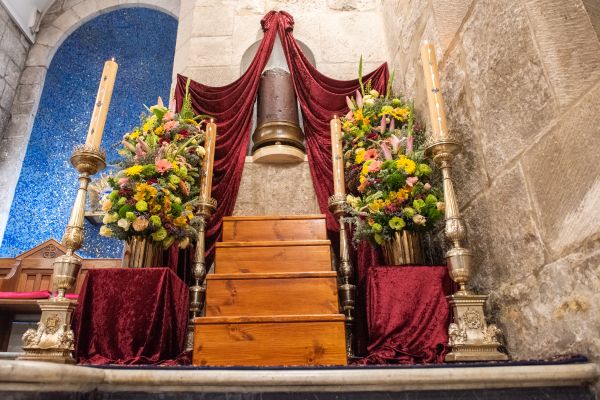

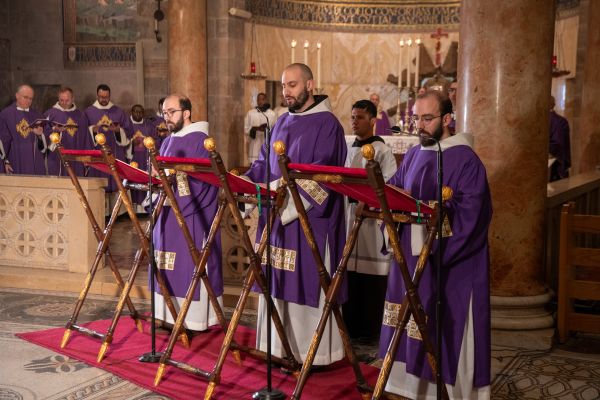
Father Alessandro Coniglio, who presided over the Mass, emphasized to CNA that “the mystery of the blood of Christ is at the heart of Holy Week. In the Old Testament, blood is the sign of life: Jesus giving his blood signifies the gift of his life for us and our redemption.”
The other stone venerated is the column of the Flagellation, whose base is now preserved in the Chapel of the Apparition (of Jesus to his mother) at the Holy Sepulcher, belonging to the Franciscans. Tradition says that while Jesus was being struck by the scourge, the column to which he was bound became stained with his blood.
“During the Byzantine era, this column was kept in the basilica of Hagia Sion (Holy Mary in Zion) on Mount Zion in Jerusalem,” Franciscan friar Stéphane Milovitch, president of the Holy Sepulcher community and director of the Cultural Heritage Office of the Custody of the Holy Land, told CNA.
Already in the fourth century, the Spanish pilgrim Egeria in her diary spoke of this column and recounted that the veneration, at that time, took place at dawn on Good Friday at the Cenacle (upper room).