

Can a religious congregation survive after its founder turns out to have been a sexual abuser and a liar who lived a double life for years? The Legionaries of Christ have spent 20 years answering that question with actions.
They were pioneers in publishing the cases of their abusive priests — an unprecedented step in consecrated life — and in submitting 80 years of a dark history to public scrutiny. Today, they are an ecclesial reference point for transparency. Now, Father Carlos Gutiérrez López, 51, the new general director elected in February, speaks with ACI Prensa, the Spanish-language sister service of EWTN News, about the road that still lies ahead.
It is a path of expiation that began in 2006 but reached a turning point in 2019 with the publication of the “1941–2019 Report,” the first of its kind to include all cases from the congregation’s founding to the present day and throughout the world. Since then, it has been updated each year through the “Truth, Justice, and Healing” reports.
“Since we began facing this reality, although it was very painful, it also opened our eyes: There was a lot of work to do,” Gutiérrez López said. “In recent years we have been working hard to meet standards, following the documents issued by the Church, collaborating with canonical and civil authorities. We have been putting a certain order in place so we can attend to and respond to the needs of victims and provide comprehensive care in different areas.”
His priestly vocation, marked by the wound left by Maciel
His own vocational story was marked by the scandal that shook the congregation because of its founder, Mexican priest Marcial Maciel, who was responsible for extremely serious sexual abuse. Gutiérrez López was ordained a priest in 2009, just as the magnitude of Maciel’s crimes was coming to light: Maciel had sexually abused dozens of minors over several decades and had lived, as the Vatican confirmed in 2010, “a life devoid of scruples and genuine religious sentiment.”
“It was definitely something very strong, something that left all of us very perplexed, frightened, and also disillusioned,” he said in an interview with ACI Prensa. “And that meant for me a very deep process of reflection in which I had to ask why I was giving my life to God and also the question: Why remain here?”
Maciel died in 2008 without acknowledging his crimes or asking for forgiveness, even though a Vatican investigative commission had already revealed his criminal activity beyond any doubt.
After the scandal, Gutiérrez López explained, the figure of the founder ceased to be a reference point: “Definitely, the founder is no longer a spiritual reference point, a moral reference point for us. And for me, that reference point, I saw, had always been Our Lord Jesus Christ, whom we seek to imitate and with whom we also seek to have that personal relationship.”
Benedict XVI saw the light that was in them
Despite all the evil committed by the founder, Benedict XVI never failed to recognize in the Legionaries of Christ “a healthy community” made up of “young people who want to serve the faith with enthusiasm,” as the pontiff himself emphasized in the book-length interview with Peter Seewald “Light of the World.”
From the beginning, the Vatican established that the congregation’s review should be built around three fundamental axes: the redefinition of its charism or spirituality; the review of the exercise of authority — whose abusive control of consciences allowed Maciel to live a double life for years — and the guarantee of adequate formation for seminarians and priests. In addition, to complete the long process of purification, a constant dialogue was opened with victims inside and outside the Legion.
“The Church accompanied us throughout a whole process of renewal. We reviewed constitutions, we reviewed many of the norms we had been living in the congregation, the style of apostolate we carried out — in short, it was an entire review that lasted many years,” Gutiérrez López said.
For many Legionary seminarians and priests, the support of the Church was decisive; like a “mother,” the Church “showed the way,” he emphasized.
“Seeing how the Legion was responding, I said: Well, I also want to help the Church with my priesthood to move this congregation forward, because the congregation can also contribute and give much to the Church in evangelization. In the end, we are here to serve God Our Lord, in the Church, and in this call that he made to me. As I have gone step by step, I have felt very happy, and that has also been my experience,” he said.
First meeting with Pope Leo XIV
During the audience the Legionaries had with Pope Leo XIV in February, the pontiff returned to several key points of the deep renewal they have carried out in fidelity to the Church. For example, he emphasized to them that authority in the Church must be lived as fraternal and spiritual service, not as a form of domination.
For the Mexican priest, this is a demanding but profoundly evangelical ideal.
“Yes, I really liked that part of the audience,” Gutiérrez López said.
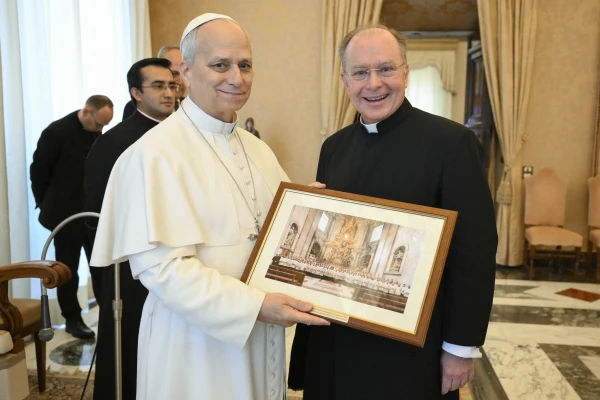
He especially highlighted the moment when the pope invited the Legionaries to approach people “with a respectful and compassionate gaze,” aware that every encounter means entering “a sacred space.”
Drawing on his own experience as a superior and as territorial director in northern Mexico and Colombia, Gutiérrez López said he has always been clear that authority is above all a service: “For my brothers, I am offering them a service. … What they share with me is something sacred, and I have to respect that sacredness,” he said.
Gutiérrez López is not naive. He knows well that many people may wonder how it is possible to separate the deplorable actions of the founder, who was responsible for so many crimes, from the charism that the Legionaries of Christ embody today.
“It is a valid question,” he said.
In this regard, he noted that it was the Church herself that “from the beginning,” when she asked the Legionaries to “review our constitutions,” placed the fundamental question before them: “What is your charism? What is the charism and the contribution that the Legion makes?”
“The charism, I believe, is something we have been discovering, and it is nothing other than forming apostles to transmit the love of Christ, to form apostles and also send them to evangelize the world and help the Church in this evangelization,” he said.
According to the congregation’s statistics, updated as of Dec. 31, 2025, the Legionaries of Christ have 1,327 members worldwide, including 52 religious with perpetual vows and 151 with temporary vows.
Despite the wounds of the past, they continue to attract vocations: Currently, 250 minor seminarians are being formed in vocational centers, reflecting the continued weight of initial formation within the congregation.
The Legionaries of Christ belong to Regnum Christi, which also includes the Consecrated Women of Regnum Christi, with 479 consecrated women in 53 communities around the world; the Lay Consecrated Men of Regnum Christi, with 47 lay consecrated men in eight communities; and lay members: 21,712 lay young people and adults older than 16 and 14,353 lay members younger than 16.
In Regnum Christi’s educational work — 139 schools and 14 universities — 153,219 students are being educated.
The new general director explained that one of the keys to eradicating abuse from within the congregation has been swiftly applying standards for the protection of minors and vulnerable adults in the 23 countries where it is present.
“In recent years we have been very strict in applying these standards and in perfecting them so they can be lived well. In each of the countries where we are working, we have sought to have the necessary teams that can respond, made up of professionals. These are things that we priests cannot do alone. We need specialists — psychologists, lawyers, and so on — to help us truly be very serious in complying with these standards,” he said.
An engineer-priest with broad international experience
Affable and approachable, Gutiérrez López is used to moving in international settings. He studied philosophy and theology at the Pontifical Athenaeum Regina Apostolorum as well as industrial and systems engineering at the Monterrey Institute of Technology. He also holds a master’s degree in psychology from Divine Mercy University in the United States.
He has carried out his ministry in Chile, Italy, Colombia, Venezuela, and Mexico.
“It has been a great richness to have that experience, to be in contact with different cultures, to know the needs of each country, to learn to listen, to adapt to what a society and a culture are like, to understand them in order to offer and bring them the message that leads to the Church, which is knowing Christ and living one’s faith,” he said.
“I believe that has also been personally enriching, now that my Legionary brothers have elected me to this role, so that I can respond and accompany the different territories,” he added.
Until his election as general director, he served as territorial director of northern Mexico, a region deeply wounded by violence, poverty, organized crime, and migration flows toward the United States. The Legionaries also try to be a balm for migrants — many of them deportees — amid their suffering.
“The whole situation of migrants and organized crime truly causes suffering for many families affected by this reality. What we seek, above all, is to form young people and families, to instill values in them, precisely so they can begin to change their social environment,” he said.
In this context, he explained that alongside the private schools the congregation operates in cities in northern Mexico, there are also the Mano Amiga schools, intended for families with limited resources and supported through subsidies and scholarships.
The goal is to offer these children an education that will allow them to enter a profession and pursue university studies — “a way to change the destiny of their lives, open horizons for them, and, above all, form them in values so they can transform their environment.”
With his election at the most recent general chapter, the Legionaries of Christ have entrusted Gutiérrez López with the task of continuing the congregation’s process of renewal and strengthening its evangelizing service, with special attention to the existential peripheries.
This story was first published by ACI Prensa, the Spanish-language sister service of EWTN News. It has been translated and adapted by EWTN News English.