

“These two little tiny, tiny babies who were aborted — she enthusiastically awaits meeting them in heaven someday, and is leaning on them for their prayers today. It was a very profound, very powerful moment to hear her articulate that,” he said.
One of the miracle stories covered in the documentary is likely known to many U.S. Catholics — the healing of James Fulton Engstrom, which the Vatican has acknowledged as taking place through the intercession of Venerable Fulton J. Sheen. Sheen, a famous evangelist and archbishop, was born in the Peoria, Illinois, Diocese in 1895 and is on the path to sainthood.
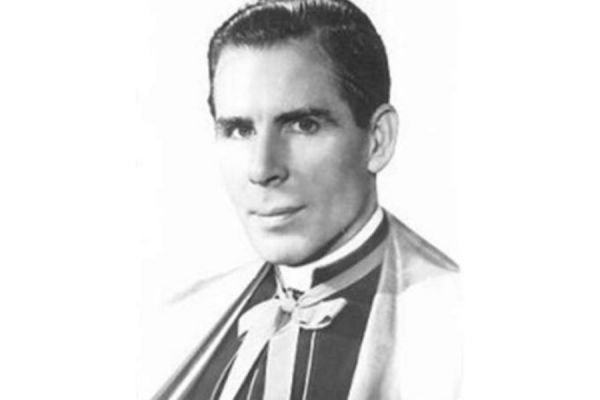
Hansen and Trummer interviewed James’ mother, Bonnie Engstrom, who faced a new parent’s worst nightmare when James was born with no signs of life. Needing a miracle, she prayed fervently for Sheen’s intercession. James is today a healthy young man despite being without a pulse for 61 minutes.
Other stories include that of Sara Reichert of rural Adams County near Quincy, who spoke about caring for her mentally challenged daughter, Hope, and how God taught her not to equate intelligence with worth. And finally, Grant Wilson spoke about his miraculous healing from constant back pain due to having different leg lengths.
Hansen said that he and a priest being “out in the world” creating the documentary provided an evangelizing witness for the Catholic faith.
“[We could] sense some people looking at us, and maybe hopefully it’s in a good way, or at least it’s in an intriguing way. But the bottom line, it shows that, hey, we are the Catholic Church. We’re going out in the world. And that’s kind of what we did with this documentary, too. It’s like, let’s go out and find these stories, and tell them,” Hansen said.
He noted that they have received a lot of positive feedback on the documentary since the premiere on July 8, including a text message from a nonpracticing Catholic who attended the premiere and was touched and edified, saying “it was nice to see Catholicism in a positive and refreshing light.”
“Most importantly, [the film] teaches the faith, promotes the faith in a positive way, and we just need more of promoting our faith in a positive way. Ultimately, we’re in the business of inspiring others and helping people in their faith journey. And you never know how a story could help someone in their faith life,” Hansen said.
The film was made on a shoestring budget of just a few hundred dollars. The unpolished, guerilla style of filmmaking actually added to the film’s “intimacy” and ultimately its success, Hansen said. He said he thinks it’s the kind of project that other Catholic dioceses could copy.
“I’m all for if another diocese wants to copy this idea. Go for it … every diocese has compelling stories to tell. And [our job] as content creators, if you want to use that phrase, is finding unique ways to tell those stories. And we thought this was a unique way, and it certainly seems people are enjoying it.”
(Story continues below)

Jonah McKeown is a staff writer and podcast producer for Catholic News Agency. He holds a Master’s Degree from the University of Missouri School of Journalism and has worked as a writer, as a producer for public radio, and as a videographer. He is based in St. Louis.