

‘You start with intolerance’
Szymanski said that autocrats, whether elected or not, persecute people of faith when they become “jealous and fearful of the mobilization of any religious leader.” She said in most cases, an autocrat tries to “push them aside or make friends [and] try to co-opt the religious leader.” If unsuccessful, she said this leads to more aggressive forms of persecution.
In some cases, such as Nigeria, Szymanski said autocrats will try to push a religious group into poverty and manipulate census data to effect “the fabrication of a minority that is irrelevant in economic and political terms.” She said this effort was used against Christians in Nigeria, despite the religion making up about half of the country’s population, as a means to facilitate an “Islamization of the country.” She said similar efforts have been used in Lebanon and India to persecute religious groups.

Szymanski also warned against “polite persecution,” which is a term often employed by Pope Francis. In these cases, political leaders avoid the direct sanction of bloodshed but instead turn members of a religious faith into “second-class citizens.” She said this is often employed as a means to improve optics on the global stage.
“It makes it legal to have citizens in your country that have less rights,” Szymanski explained.
The report found that a hybridization of “polite” persecution and outright bloodshed is on the rise. Szymanski said some autocrats will impose laws that infringe on a religious group’s freedom and “look the other way” when there are bloody attacks without openly sanctioning them.
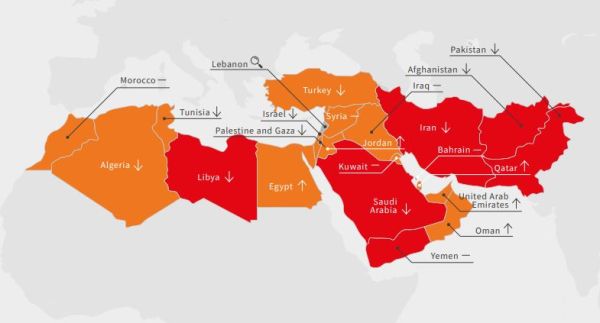
The less severe category, which is the “orange” category, denotes a country in which there is state-imposed discrimination and failing to provide protection or justice for the victims of physical attacks. The report listed another 33 countries in this category, which are home to more than 850 million people.
Szymanski warned that discrimination will sometimes lead to outright persecution, noting that “you start with intolerance.”
“It’s first intolerance, then discrimination, then persecution, and then genocide,” she said.
The “orange” category also included three countries that were not listed in the previous report: Israel, Haiti, and the United Arab Emirates. In 13 of the countries that were rated “orange,” the conditions had gotten worse than they were in the previous report.
(Story continues below)
Even in countries that did not receive an “orange” or “red” categorization, the report noted that this “does not necessarily mean all was perfect in matters relating to religious freedom.”
The report listed 12 sub-saharan African countries, three Latin American countries, four mainland and maritime Asian countries, one Middle Eastern country, and three European countries as “under observation,” which means that newly emerging factors have been observed that could threaten religious freedom.
Among the countries under observation are Russia, Ukraine, and Belarus. Szymanski said that much of the religious freedom concerns stemming from the Russo-Ukrainian War happened after the researchers compiled its data for this report and that it will be considered in the next report.
The report also highlighted concerns of declining religious freedom in the West, such as hate speech laws, compelled speech, censorship, the rise of cancel culture, and religious freedom restrictions during the COVID-19 pandemic.

Tyler Arnold is a staff reporter for the National Catholic Register. He previously worked at The Center Square and has been published in a variety of outlets, including The Associated Press, National Review, The American Conservative and The Federalist.