

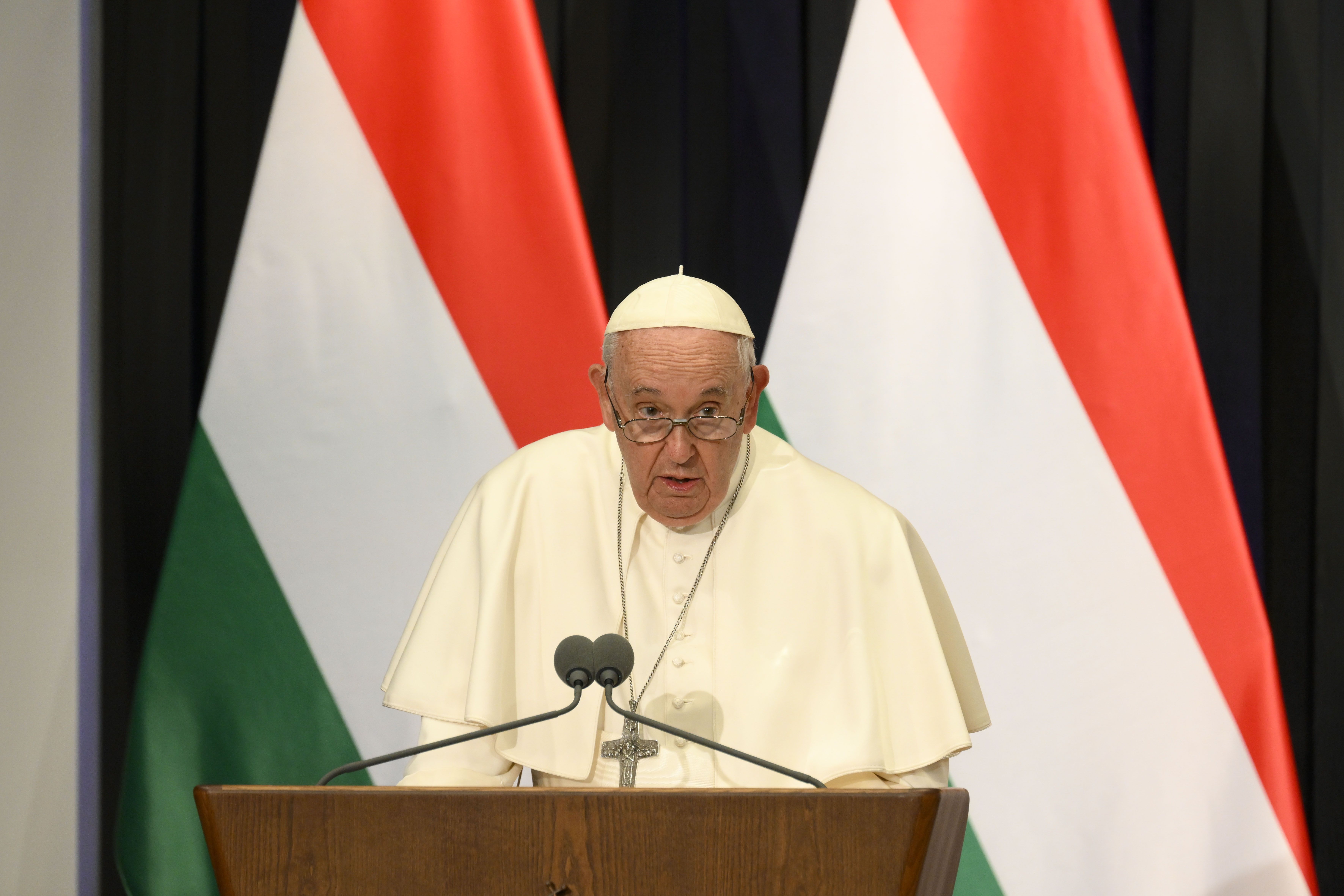
Before his address, delivered in a former Carmelite monastery in Budapest’s Castle District, Pope Francis met with Hungary’s President Katalin Novák and Prime Minister Viktor Orbán, whose conservative policies, many of which aim to preserve and strengthen the nation’s Christian identity, have placed Hungary’s government at odds with more liberal members of the European Union.
In his remarks, the pope made no direct reference to the ongoing war in Ukraine, Hungary’s neighbor to the northeast. Instead, he spoke broadly of an urgent need to “generate forms of diplomacy capable of pursuing unity, not aggravating differences.”
Pope Francis placed Hungary, a historically Christian nation with a rich tradition of statesmanship, and Budapest itself, forged 150 years ago out of three separate cities, at the center of this leadership challenge.
“I think of a Europe that is not hostage to its parts, neither falling prey to self-referential forms of populism nor resorting to a fluid, if not vapid, ‘supranationalism’ that loses sight of the life of its peoples,” the pope said. “This is the baneful path taken by those forms of ‘ideological colonization’ that would cancel differences, as in the case of the so-called gender theory, or that would place before the reality of life reductive concepts of freedom, for example by vaunting as progress a senseless ‘right to abortion,’ which is always a tragic defeat.”
The Holy Father offered a different vision for Europe’s future. “How much better it would be to build a Europe centered on the human person and on its peoples, with effective policies for natality and the family — policies that are pursued attentively in this country — a Europe whose different nations would form a single family that protects the growth and uniqueness of each of its members,” he said.
In a sense, the pope said, the city of Budapest symbolizes that vision.