
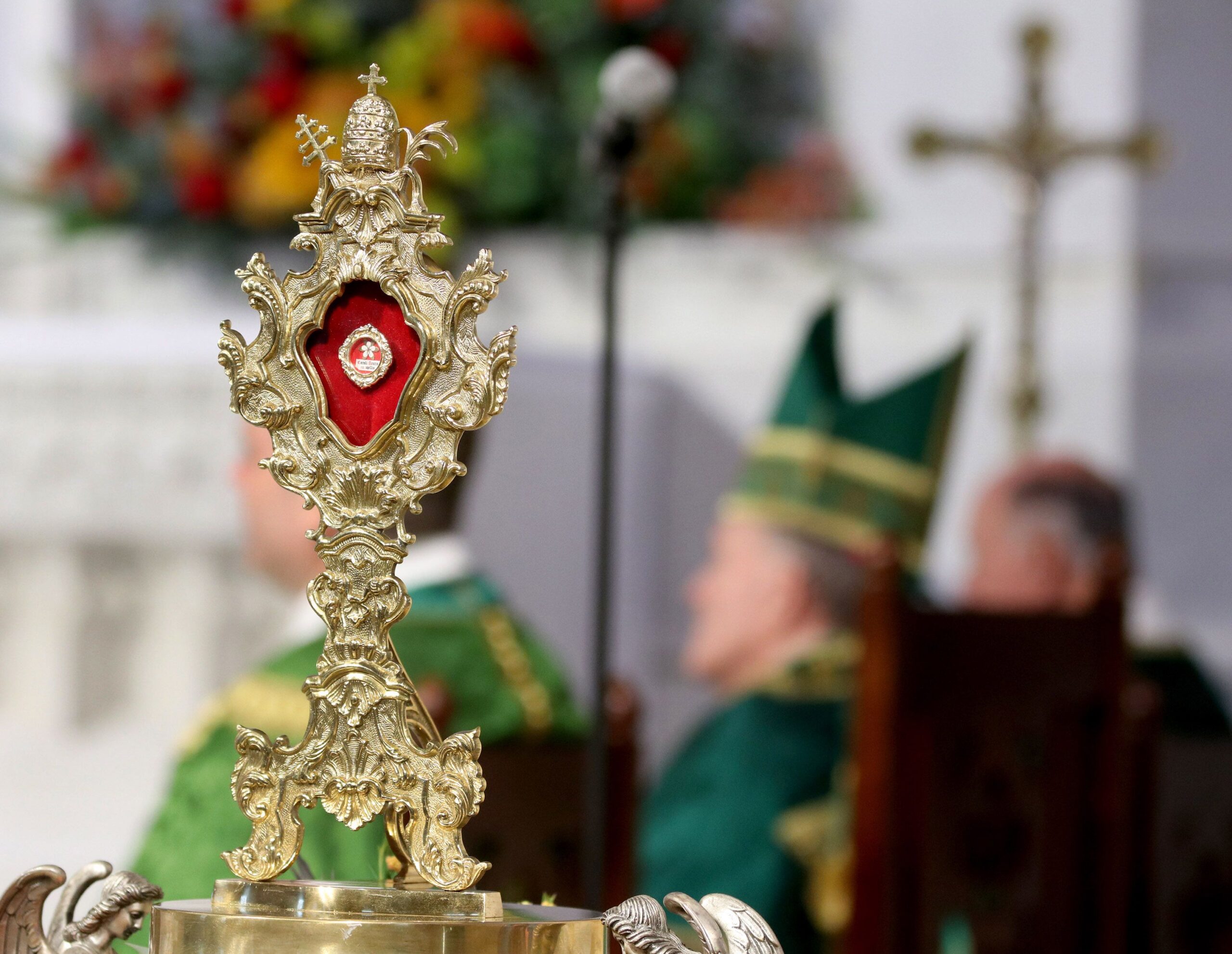
A relic of Blessed Carlo Acutis’ heart (pericardium) from Assisi, Italy, will be on display in the congress reliquary. The Italian teenager who died in 2006 is known for his devotion to the Eucharist and his passion for technology. He called the Eucharist “my highway to heaven” and used his computer skills to catalog Eucharistic miracles from around the world. Diagnosed with leukemia at the age of 15, Carlo offered his suffering for the Church and the pope. Pope Francis has put forward Acutis as an example for young people and recently approved his canonization as the first millennial saint, expected during the Catholic Church’s 2025 Jubilee Year.
Acutis’ Eucharistic Miracles Exhibit will also be on display in the Indiana Convention Center each day of the congress.
St. Paschal Baylon
St. Paschal Baylon was born on the feast of Pentecost in 1540 in Torrehermosa, Spain. A humble shepherd who joined the Franciscan order as a lay brother, he was known for his deep piety and devotion to the Blessed Sacrament. Despite his lack of formal education, he was revered for his wisdom and spirituality. He was canonized in 1690 by Pope Alexander VIII and declared the patron saint of all Eucharistic congresses and associations by Pope Leo XIII.
A relic of Baylón’s mummified finger is provided to the Eucharistic congress from the Shrine of All Saints in Chicago.
St. Junípero Serra
St. Junípero Serra was a Franciscan missionary who played a pivotal role in the establishment of the California mission system. The missionary saint from Mallorca, Spain, arrived in Mexico in 1749 and later moved north to found the first nine of 21 missions in California, starting with San Diego de Alcalá in 1769. His efforts significantly influenced the spread of Christianity in the American West. Pope Francis declared Serra a saint in the first canonization on U.S. soil in 2015.
St. Juan Diego
St. Juan Diego is best known for his encounters with the Virgin Mary, who appeared to him as Our Lady of Guadalupe in 1531. The Virgin Mary instructed Diego to build a church in her honor, leaving her image miraculously imprinted on his tilma as proof. The Mexico City basilica that now houses the tilma has become one of the world’s most-visited Catholic shrines. Pope John Paul II beatified St. Juan Diego in 1990 and canonized him in 2002.
St. Elizabeth Ann Seton
A pioneer in American Catholic education, St. Elizabeth Ann Seton was the first native-born American to be canonized as a saint. Seton was born into an Episcopalian family in New York City in 1774. After her husband’s death, she converted to Catholicism and founded the Sisters of Charity, the first American religious community for women. She established schools and orphanages, laying the foundation for the Catholic parochial school system in the United States.
(Story continues below)
Subscribe to our daily newsletter
The Bishop Simon Bruté College Seminary in Indianapolis provided Seton’s relic for the congress.
The Veil of Mary
A piece of a relic of the Veil of Our Lady from the Chartres Cathedral in France will be displayed for veneration at the National Eucharistic Congress. The veil, also known as the Sancta Camisa, has been preserved and venerated in the Chartres Cathedral since the 10th century. This piece of the veil belongs to Holy Rosary Church in Indianapolis and is on loan for the congress.
The Shroud of Turin
Visitors to the National Eucharistic Congress will also have the chance to see a replica of the Shroud of Turin, which is part of an educational exhibit on display in the Wabash Ballroom Three of the Indiana Conversion Center each day of the congress.