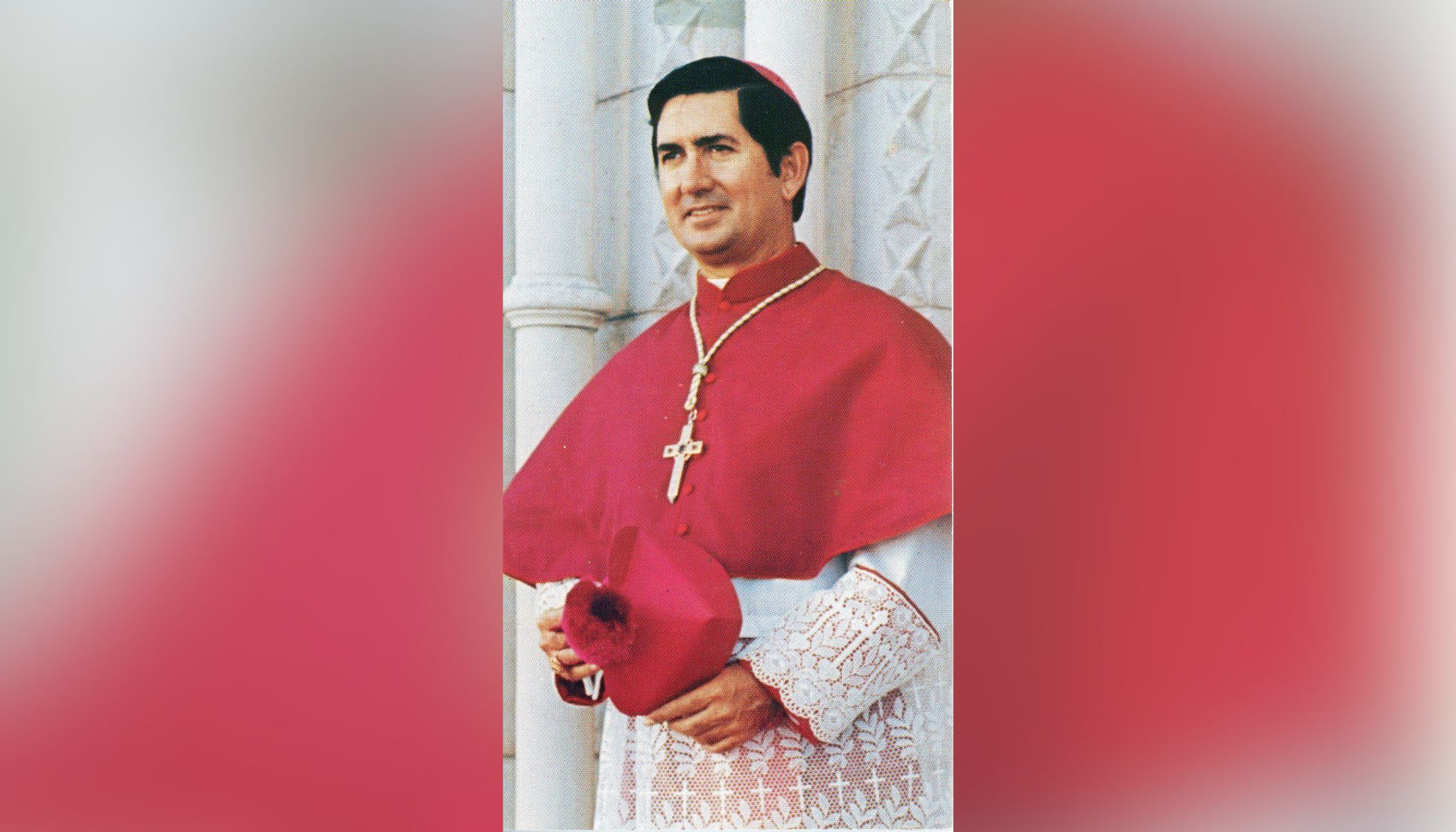

Bishop René Henry Gracida, who led multiple U.S. dioceses and whose career included combat service as a U.S. Army Air Corps tail gunner over Germany in World War II, died on May 1. He was 102 years old. His death was announced by the Diocese of Corpus Christi, Texas.
The long-lived prelate, who was ordained in 1959 and appointed a bishop by Pope Paul VI in 1971, was the bishop emeritus of Corpus Christi since his retirement in 1997. He was appointed to that diocese in 1983 and had previously served as the bishop of Pensacola-Tallahassee, Florida, and as an auxiliary bishop of Miami.
Born in New Orleans on June 9, 1923, Gracida said that as a young man he was captivated by the depiction of Jesuit martyrs in James Fenimore Cooperʼs 1826 novel "The Last of the Mohicans."
He told the journalist Jim Graves in 2016 that upon entering the Benedictine monastery he took the name of the Jesuit martyr Rene Goupil, who was tortured and martyred by Iroquois in 1642.
Among the dwindling number of World War II veterans still alive, Gracida served with distinction in the U.S. Army Air Corps, flying multiple missions over Nazi-occupied Europe. In one mission over the Ruhr Valley his airplane lost two engines, leading him to nearly bail out over enemy territory before the craft recovered.
His flying career did not end after World War II. He told Graves that following a stint in the hospital in 1972 after he drove across Southern Florida performing dozens of confirmations, he acquired a pilotʼs license and a small aircraft, which allowed him to fly around the archdiocese rather than spend long hours on the road.
In several instances, he said, he blacked out during intense thunderstorms, waking up at different altitudes than when he lost consciousness. “It’s another example of God preserving my life,” he said.
Gracida said that he considered EWTN foundress Mother Angelica a friend. In his 2005 biography of Mother Angelica, Raymond Arroyo noted that when the U.S. bishops debated the extent of their collaboration with EWTN in 1988, Gracida “cinched the deal” by proposing that the bishops adhere to a secret ballot when voting on any disputes.
Gracida was among the signatories of the Aug. 11, 2017, “filial correction” addressed to then-Pope Francis over the Holy Fatherʼs apostolic exhortation Amoris Laetitia.
In his later years he was known for expressing a number of controversial views, including a claim that Pope Benedict XVIʼs 2013 resignation was invalid. He was a vocal supporter of the Traditional Latin Mass.
In announcing his death, the Diocese of Corpus Christi said that under his leadership it developed its communications arm and expanded ministries throughout the diocese.
A trained architect, the bishop reportedly reviewed all diocesan building proposals before they were sent to construction. The bishop in his retirement “remained active and was an avid hunter and fisher,” the diocese said.
Earlier this year, in a statement to the advocacy group Catholics for Catholics, he exhorted listeners to “keep the faith.”
“As long as your faith is a motivating factor in your life, guiding what you do, youʼre on the right track,” he said.
He told Graves in 2016 that his many brushes with death — including a near-fatal case of pneumonia in the 1950s — led him to believe that he was kept alive for a purpose.
“I have no doubt that the only reason I’m alive today … is because God has work for me to do,” he said at the time. “I have a message to deliver; God has kept me alive to deliver it.”