
Catholics not plentiful
The state of Virginia is only about 8% Catholic, according to a 2021 University of Virginia study — and less so in the mostly rural southwestern part of the state.
That makes the basilica designation particularly meaningful for Catholics who attend St. Andrew’s.
“It just confirms the fact that Catholicism is alive and well in southwest Virginia. And that church has stood there for more than a hundred years as a symbol of that,” said Susan Thompson, 74, who taught for 32 years at next-door Roanoke Catholic School, most of that time running the school’s prekindergarten through grade 7 program.
The church building has a magnetic quality that draws strangers in and changes them for at least a short while, one parishioner said.
“When you come out of Mass many times you’ll just see people standing in the parking lot looking at it. They know it’s a church but they don’t know what denomination. They’re just curious. And then when they come in, it takes their breath away,” said Grimes Creasy, 62, a civil-law attorney and member of the parish council. “And then they get very reverent. That’s the interesting thing. You can see their body posture change. They recognize they’re in a holy place. They just kind of straighten up.”
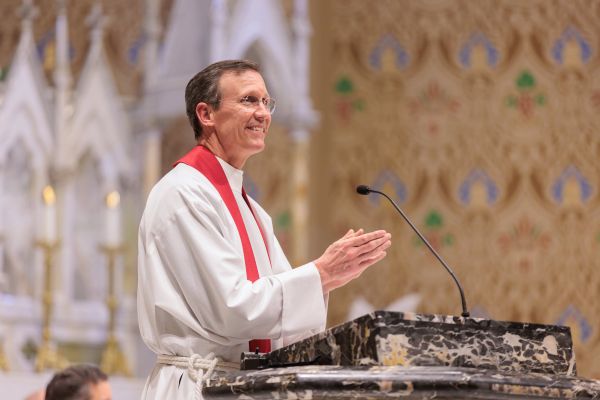
Bishop Barry Knestout, who heads the Diocese of Richmond, plans to read the Vatican’s official announcement and bless physical symbols signifying the church’s elevation to basilica during a Mass at St. Andrew’s on Sunday, December 3.
“With this decree, I hope more individuals will be drawn to visit this special treasure, and in doing so, will draw more to inquire about our faith,” the bishop said in a written statement Thursday.
He tied the basilica announcement to the U.S. bishops’ current three-year National Eucharistic Revival.
“May this basilica continue to be a place of personal encounter with Christ, a place of robust faith formation, and through its beauty — externally and in the liturgy — elevate the hearts and minds of all who attend Mass here,” Knestout said.
(Story continues below)
Subscribe to our daily newsletter
What is a basilica?
A basilica in the Catholic Church is a church building singled out for honor by the pope for its beauty and renown. Most are large.
A basilica doesn’t need to be a cathedral — a word that comes from the Latin cathedra, or chair, which symbolizes the authority of the bishop. Most basilicas aren’t cathedrals. And most cathedrals aren’t basilicas. But some churches are both.
The “mother church” of the Catholic Church is St. John Lateran, the cathedral of the Diocese of Rome, which has the pope’s cathedra. It is a so-called “major basilica,” along with the more famous St. Peter’s Basilica. The other two major basilicas are St. Paul Outside the Walls and St. Mary Major. All four are in Rome.
Outside Rome, a diocese’s cathedral “holds the first place and the greatest dignity” in a diocese, because the bishop’s chair in the cathedral is “the sign of the bishop’s teaching authority and power, as pastor of the same diocese, and the sign of communion with the Roman cathedra of Peter,” according to a 1989 Vatican document called Domus Ecclesiae (“House of the Church”).
But certain church buildings may be honored by the pope with the title “minor basilica” because of their “particular importance for liturgical and pastoral life,” according to the Vatican document, which sets out criteria for applying for minor basilica status.