
The Quebecois cardinal said his dicastery mostly has been choosing “pastoral bishops,” but depending on the needs of the local Church, they also look for men with “good canonical preparation, with a good theology.”
“It is a discernment that is done very precisely, after the study of the place,” Ouellet said.
It is the cardinal’s responsibility to bring the “terna,” a report of three candidates for archbishop, bishop, or auxiliary bishop of a diocese, to the pope for selection.
Ouellet will present the opinions of the dicastery to Pope Francis, who makes the final selection.
“Every week, an hour with him, we’ve been addressing so many questions,” the cardinal said. “I’ve seen him react as a man of God that is listening to the Spirit, having his signs to discern exactly the motion of the Spirit.”
Another important quality Ouellet has noticed in Pope Francis is his ability “to withdraw when he thinks ‘I went too far. I had a sort of impulsive move.’”
“He is able to correct himself. I’ve had some examples I will not give you,” the cardinal said with a chuckle. “But [he is] really a man of God, a man that follows the Spirit. That’s my experience of him.”
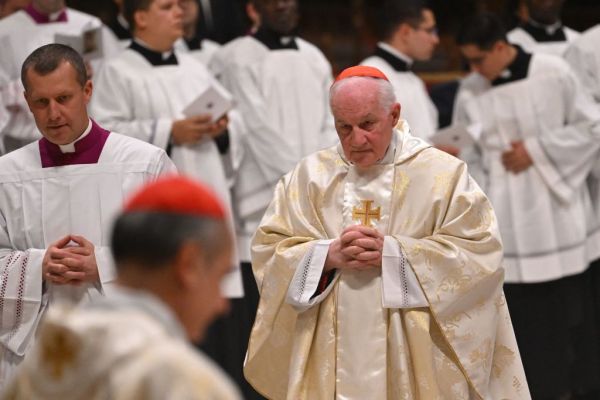
According to Ouellet, Pope Francis’ pastoral style has also had an impact on his papacy in other ways — including his communication style.
“He has been giving interviews to journalists — you had never seen that before … and in a very spontaneous way,” he said. “He has been doing interviews for books, and looking for all the occasions to speak to the people, and so to be present among the people. That’s his pastoral style.”
The cardinal also pointed to Pope Francis’ initiatives for interreligious dialogue, including the Document on Human Fraternity for World Peace and Living Together, which he signed with Sheikh Ahmed el-Tayeb, grand imam of Al-Azhar, in Abu Dhabi in 2019.
(Story continues below)
The Abu Dhabi declaration “is so important for the peace in the world,” Ouellet said. “It is not easy to deal with the Muslim, the Islamic community. It is difficult, and there is a real need for encounter, for better understanding of dialogue, in a word. He has been [making] many efforts in that direction.”
Cardinal Ouellet has also been president of the Pontifical Commission for Latin America since 2010.
He said South America is the continent “where the divide between rich and poor is greatest.”
“The pope has come to the See of Peter with the poor in his heart. And he has put the poor at the center of the Church,” he explained.
“I think this is the main contribution of Pope Francis from Latin America, this sensitivity to the poor,” Ouellet explained. “It is a lesson for the whole world: If you put the [poor at the center] you put everybody on mission, because mission begins with love, with charity, otherwise, your word has no impact, if it is not accompanied by your gesture. And that’s a characteristic of Pope Francis.”
Cardinal Ouellet also noted the Catholic Church’s clerical culture and emphasis on the ordained ministry. He believes the Church needs to increase awareness of the priesthood of the baptized, which every Catholic belongs to.