

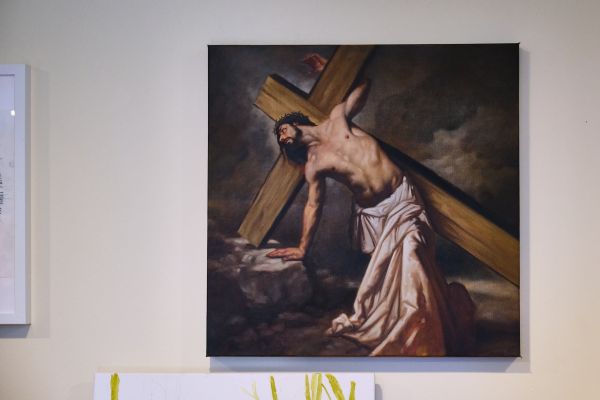
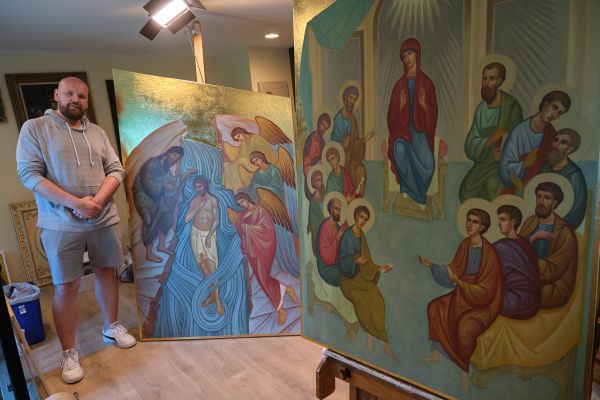
Referring to the non-Byzantine images around his studio, he said: “Realism is more like my personal conversation with God, and Byzantine iconography is more like the Our Father. Of course, personal prayer should be there, but [the Our Father] is a stable, unchanging prayer, that if you do it will give you a personal connection with God.”
Byzantine iconography, with its rigid structure, “is that stable, unchanging prayer,” he said.
Kolodka is also going to create a faithful reproduction of the divine mercy image that hangs in Holy Rosary Cathedral and in many local parishes.
“One of the places we want to offer something unique is at the Holy Rosary Cathedral,” Ozorovych said. “They have an amazing icon of Our Lady of Guadalupe to the right of the altar that is a high-quality piece of art. It has power to it.”
The current divine mercy image will be replaced with a faithful reproduction of the divine mercy image that is in the Divine Mercy Sanctuary in Krakow, Poland, with four additional paintings paying homage to the four apparitions depicted in Nicolás Enríquez’s 1773 painting of the Virgin of Guadalupe.
In addition to the religious paintings, Kolodka is working on political paintings reflecting the war raging in Ukraine.
He is especially interested in talking about his allegorical painting depicting Ukrainian military and journalists currently working in Ukraine as they write a fictional letter to Vladimir Putin.
The image pays homage to Ilya Repin’s late 19th-century oil painting “Reply of the Zaporozhian Cossacks,” which depicts an event from 1676 in which the Zaporozhian Cossacks (from southeast modern-day Ukraine) penned an insulting letter to the Ottoman Sultan in response to his demand that they surrender after they defeated the Ottoman army in battle. The painting is a symbol of national identity for Ukrainians.
Kolodka’s painting is not just a political statement but is meant to contribute to the history of the Ukrainian war as a document of the emotions and grit of the Ukrainian people.
(Story continues below)
Kolodka was also involved in an exhibit featuring artwork by Ukrainian art students to raise funds for Ukrainian support.
This article originally appeared in The B.C. Catholic and is reprinted here with permission.

Nicholas Elbers is a reporter for The B.C. Catholic, the newspaper of the Archdiocese of Vancouver, Canada.