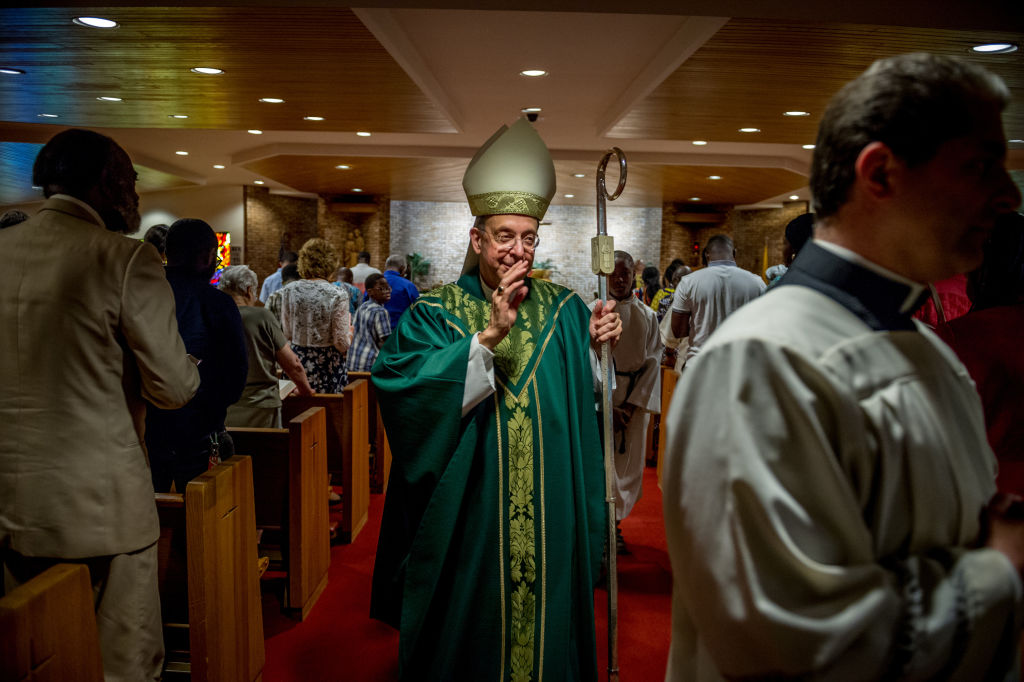

Baltimore Archbishop William Lori this week praised an assembly of women religious major superiors for their witness of “evangelical poverty,” with the prelate noting the outsized influence that women religious have had on American society over the past 250 years.
“You and those who came before you have taught our children, tended to the sick, welcomed immigrants, accompanied the dying, consoled the brokenhearted, and proclaimed Christ where no one else was willing to go,” the archbishop told the major superiors on Sept. 18 in Florissant, Missouri.
“For that, the Church gives thanks. But gratitude alone is not enough. The Church also looks to you with hope,” he said.
The archbishop spoke at the 2026 National Assembly of the Council of Major Superiors of Women Religious, the theme of which was: “250 Years of Freedom: Daughters of the Church from One Generation to the Next.”
The council comprises major superiors and vicars from 112 religious communities around the U.S. The group describes its national assembly as “the springboard for collaboration, participation, and dialogue among members” which “promotes unity among the major superiors that gives witness to the joy of religious life.”
Addressing the gathering as the keynote speaker, Lori acknowledged the assembly’s recognition of the 250th anniversary of the founding of the United States.
The U.S. has been instrumental in advancing religious freedom and human dignity across the world, the archbishop argued. He noted that most histories of the founding of the U.S. focus on the Founding Fathers such as George Washington, Thomas Jefferson and others.
But “the American experiment would have looked very different” without the contributions of “thousands and thousands of women religious,” he said.
“Who welcomed wave after wave of immigrants? Who cared for the victims of epidemics when others fled? Who taught generations of children not simply arithmetic and grammar, but honesty, sacrifice, discipline, and love of God?” he said.
Women religious “changed the nation because they first allowed Christ to change them,” the archbishop said. He noted the “paradox” in which those who take vows of poverty “enriched countless communities” and those who “renounced worldly ambition” often “exercised the greatest influence upon society.”
“The world struggles to understand this paradox,” Lori said. “The Gospel does not.”
Women religious have historically both upheld the ideals of America while challenging it when it “falls short of the Gospel,” Lori said.
He cited the witness of St. Frances Xavier Cabrini’s “evangelical poverty” as she carried out the founding of schools, hospitals and orphanages around the world.
And he further pointed to the work of Servant of God Sister Mary Thea Bowman, praising her for her “profoundly Catholic way” of confronting racism while evangelizing about the love of Christ.
Urging the women religious to pursue “an ever-new embrace of the heart of your vocation,” Lori told the assembly: “The world needs women who have been seized by Christ.”
“It needs women whose lives bear unmistakable witness to the truth that God is real, that holiness is possible, that sacrifice is fruitful, and that love poured out in communion with Christ can transform the world,” he said.