
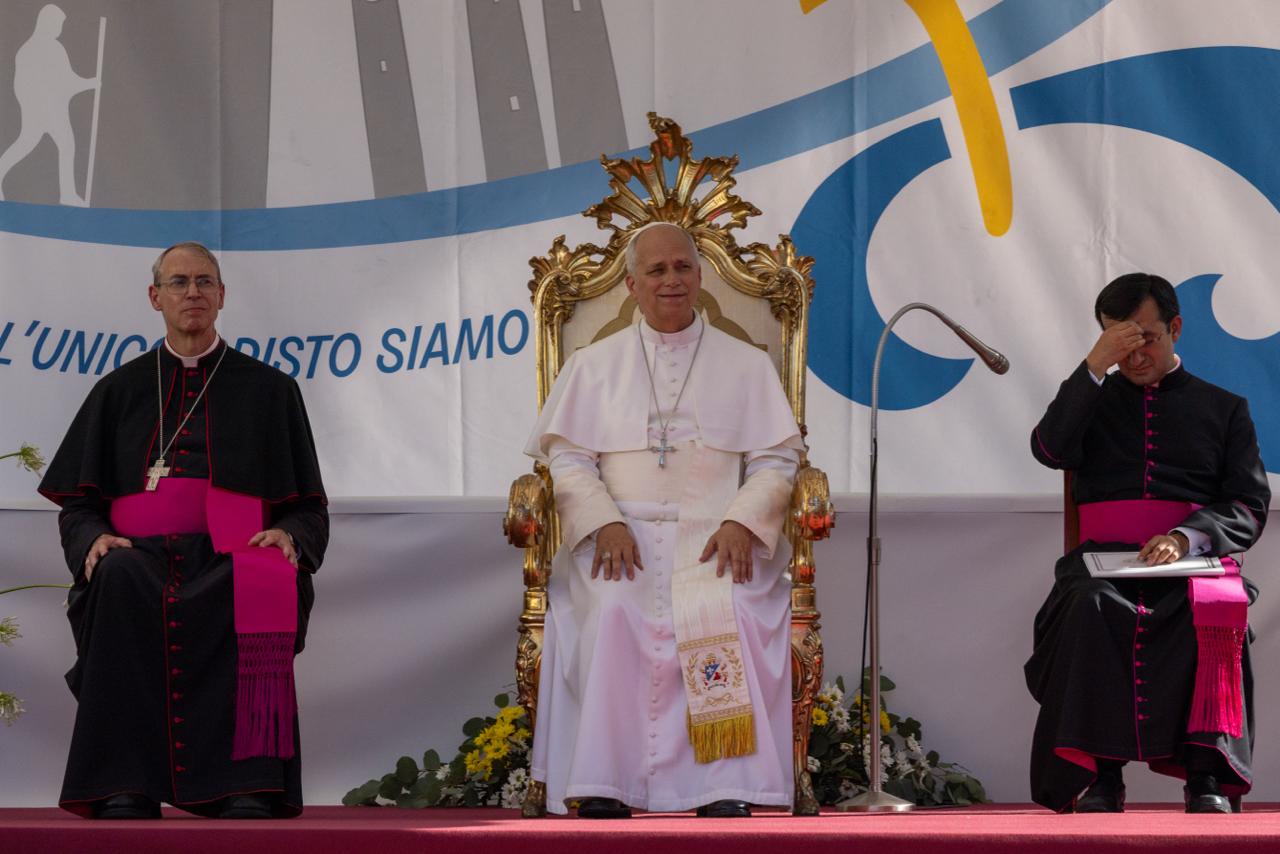
PAVIA, Italy — Pope Leo XIV on Saturday visited the Basilica of St. Peter in Ciel d’Oro in Pavia, where the relics of St. Augustine are kept, in what amounted to a kind of homecoming for the Augustinian pope.
The basilica, whose construction began in the eighth century, has housed the mortal remains of St. Augustine since around the year 722, when they arrived in Pavia from Cagliari. The relics had previously been brought to Sardinia from Hippo in 504.
The June 20 stop continued Pope Leo’s Augustinian itinerary. In April, during his apostolic journey to Algeria, the pope visited Annaba, the ancient Hippo, where Augustine served as bishop.
Upon his arrival at the basilica, Pope Leo was welcomed by Father Joseph L. Farrell, prior general of the Order of St. Augustine; Father Gabriele Pedicino, provincial prior; and Father Gianfranco Casagrande, prior of the convent. The pope then met with the Augustinian community and, later in the cloister, with bishops of the Lombardy Episcopal Conference.
The last papal visit to the Basilica of St. Peter in Ciel d’Oro took place in 2007, when Pope Benedict XVI came to Pavia and was welcomed by Father Robert Francis Prevost, then prior general of the Order of St. Augustine.
Greeting those present in the cloister, where about 1,800 faithful were gathered inside and outside the basilica, Pope Leo spoke briefly off the cuff.
“I know many of you,” he said. “St. Augustine teaches us to live and to love God and our brothers and sisters. Fraternal love and charity toward all are important; this is the message of Jesus and of St. Augustine. We are signs of love and charity, and we know how to live forgiveness, reconciliation, and peace.”
In his greeting to the Augustinian community, Leo said that “St. Augustine is not ours; he belongs to the Church, and our mission is to make him known in the Church,” because Augustine “has so much to offer in this time.”
The pope said it is necessary “to offer the message of love for Christ and love for the Church,” adding: “May St. Augustine always help us to live this mission.”
In his address in the basilica, Pope Leo praised the Church in Pavia as “a community of ancient tradition that remains alive and present in the city and territory, attentive to the signs of this time and to its challenges, without allowing itself to be discouraged by fatigue, by the secularized context, and by the difficulties in transmitting the faith.”
To avoid discouragement, he said, Christians need “a gaze animated by the spirit of faith” that helps them read reality more deeply and resist “a negative and pessimistic attitude, incapable of generating new life.”
“The gaze that is required of us is instead that of Jesus,” he said.
The pope asked what it means to be “a living Church,” answering that it requires remaining united to Christ, “the living stone, rejected by men but chosen by God.”
“Christ is the foundation of the spiritual building,” Leo said. “He is the cornerstone placed as the basis of our ecclesial journey, of pastoral action, and of evangelization.”
Being built in Christ, he said, protects the Church from the risk of becoming scattered or exhausted by “secondary things” that may be good but do not reach what is essential.
“Since the center is Christ, we all draw from this one source and submit our efforts to the discernment that comes from his light and his word,” the pope said. “Then we help grow a Church in which people walk together, capable of renewing itself without division, in which all recognize one another as brothers and sisters and work joyfully in service of the kingdom of God.”
Leo urged Christian communities to be centered on what is essential, “even if this should involve giving up some structures and some securities of the past.”
“The essential thing is to live with Christ, and spreading his Gospel is what must be close to our hearts,” he said.
The pope addressed that appeal first to priests, calling them to “always return to the center” and to unify everything in their relationship with the Lord. He also encouraged men and women religious, who he said often know the fatigue of updating the charism to which they belong, to begin again from Christ and share their gifts with the whole diocesan Church.
In a secularized world, Leo said, Christians are called above all to bring “the joyful and liberating proclamation of Jesus Christ” and to help people discover or rediscover the faith.
The pope then pointed again to Augustine, saying that “his thought, the story of his conversion, and his spirituality remind us of the value and primacy of interiority.”
“As living stones, we are called to be a Church well rooted in the territory,” Pope Leo said, “a Church that walks amid the struggles and hopes of the people, expert in the art of listening and accompanying.”
He emphasized the importance in Pavia of university pastoral ministry and dialogue with culture, saying that study and scientific work challenge believers to offer a faith capable of illuminating the human search for truth, justice, and beauty.
Before the pope’s address, Bishop Corrado Sanguineti of Pavia described the local Church as “a Church on the journey,” marked by growing communion among religious communities, associations, movements, and pastoral efforts to reach people in the concrete circumstances of their lives.
Farrell, the Augustinian prior general and Prevost’s successor, also addressed the pope. He said Pope Leo’s presence among the Augustinians had “inestimable meaning,” because they are “historically and spiritually, sons of the Church and sons of St. Augustine.”
“We have St. Augustine for a father and the Church for a mother,” Farrell said, noting that the words would sound familiar to Leo because they were the same words then-Father Prevost had addressed to Pope Benedict XVI during his 2007 visit to Pavia.
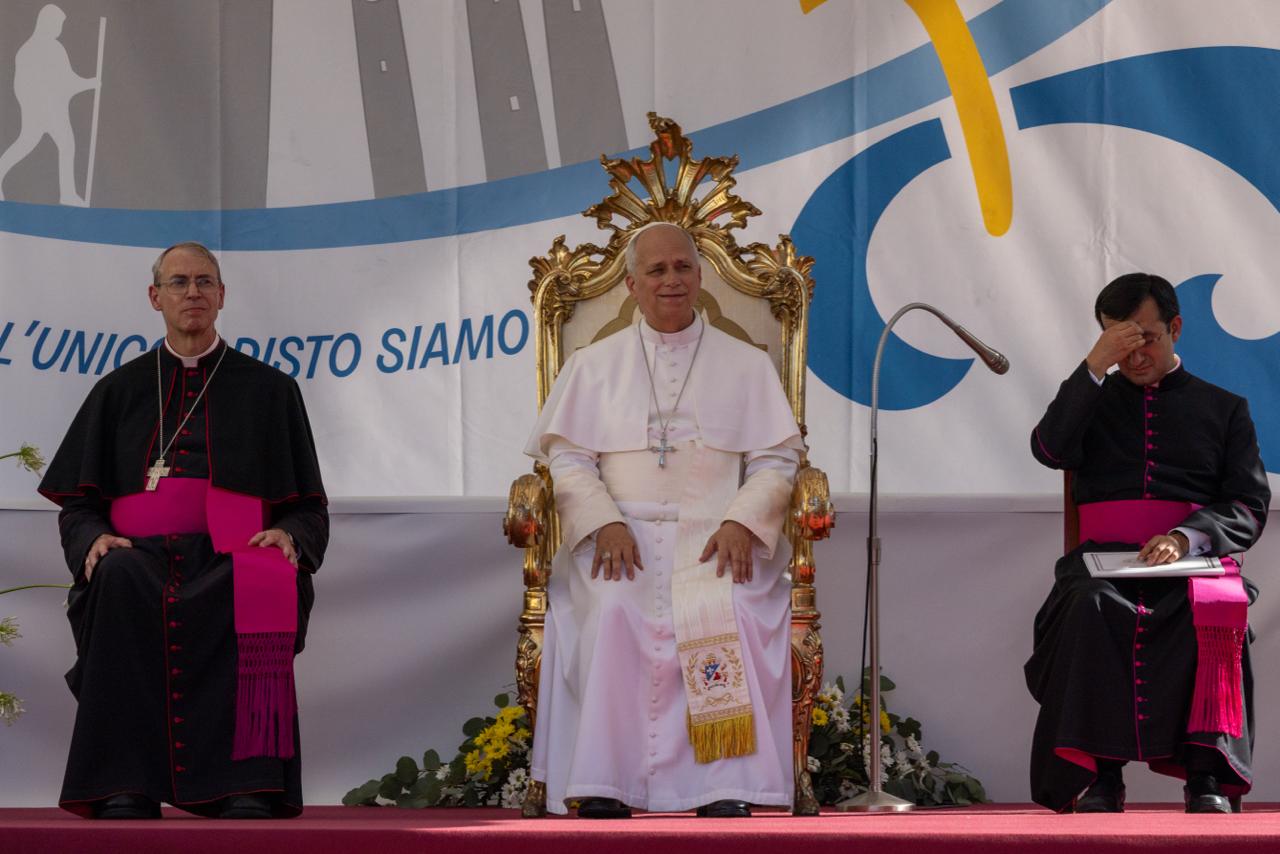
After leaving the basilica, Pope Leo went to Piazza Duomo, where he prayed before the Blessed Sacrament and venerated the relics of St. Syrus, the first bishop of Pavia.
On the steps of the cathedral, the pope blessed a heated cradle intended for abandoned newborns and prayed before the image of Our Lady of Colombina. The then-Cardinal Prevost had been expected to visit the shrine of Colombina last year, but his election to the papacy made the visit impossible.
Speaking off the cuff on the cathedral steps, Pope Leo greeted young people and the large Peruvian community present in the city.
“We all want to live in peace,” he said. “It is very important that we never lose hope. But, as St. Augustine told us, if we want to change the times, if we want the world to live in peace, we must begin with ourselves.”
“That means no more words of hatred, no more insults, no more bullying, no more all those things that create war between people, between communities, between countries,” the pope said. “We must all learn to be builders of peace and promoters of reconciliation.”
After the visit to the cathedral, Pope Leo walked despite the intense heat to Piazza Vittoria for a meeting with the city’s residents.
The beauty of Pavia, Leo said, is demanding because it represents “the precious inheritance of a past that becomes a commitment for the present.”
“The city is in fact a gift and a task for those who live there,” he said.
Referring to schools, universities, hospitals, and parishes, the pope said they are “significant places” that testify to welcome, education, and culture. In different ways, he said, they attest to “the same care for the person-in-community, with his dignity and his values,” which unite citizens as one people and also underlie the Italian Constitution.
The city, Pope Leo said, points to “a human condition: The city is one for all; it is singular and plural.”
“To be social means to be solidary, behaving as authentic partners, motivated by the common good and not by partisan interests,” he said. “Citizens are always fellow citizens.”
Speaking before about 3,500 people gathered between the cathedral and Piazza Vittoria, the pope warned against indifference and called for renewed participation in civic life.
“When indifference seems to break apart our community, it is necessary to renew the active participation of all in city life,” he said. “Faced with forms of degradation and civic illiteracy, we are called to share languages of dedication and service, which safeguard squares, parks, and streets as places of encounter par excellence.”
Good citizenship, he said, “knows how to cultivate concord through dialogue and constructive encounter among the people and cultures that animate Pavia.”
“Today I invite each of you to repeat within yourselves: I care about our city,” the pope said. “I care about the health of the person next to me. I care about the beauty of the place where I live. I care about the quality of life in the environments where I work and where I spend my free time.”
Leo also highlighted the University of Pavia, saying its students experience not “an agglomeration of knowledge” but a system capable of forming the person “without speculating on his labor.”
“To promote the sciences, in fact, means to promote man, who must always remain the protagonist of his own research,” the pope said. “To every form of knowledge there corresponds a form of care.”
Returning to Augustine, Leo said “one cannot believe without thinking, nor is it possible to illuminate the highest questions of reason without faith.”
“With this trusting openness, human reason asks and plans,” he said. “It does not close itself within the logic of profit or domination but discovers new ways to care for itself and for the world.”
Faith, he added, reminds people that they are not “subjects of an anonymous fate” but are sustained by the certainty that God is “creator and savior of life.”
“Thanks to your commitment, Pavia is prosperous not only in goods but also in virtues: Always honor the dignity of every human life!” he said.
Earlier in the day, Pope Leo began his brief but intense visit to Pavia at the National Center for Oncological Hadrontherapy, known by its Italian acronym CNAO.
The papal helicopter landed in Pavia shortly before 2:40 p.m. on a day of particularly high temperatures. The pope was welcomed by local authorities and Sanguineti.
“Great emotion, an atmosphere of joy, a hot day because of the heat — we think it is a beautiful moment for everyone and an experience of faith for many,” the bishop told accredited journalists gathered in the press room inside the bishop’s residence.
The cancer center, inaugurated Feb. 15, 2010, treats patients with solid tumors that cannot be cured surgically or with traditional radiotherapy, using hadrontherapy: irradiation with beams of protons and carbon ions.
CNAO was the first center dedicated to hadrontherapy in Italy and remains the only one in the country able to offer carbon ion therapy.
Inside the facility, the pope greeted administrators, medical staff, and several children undergoing treatment at the center, together with their parents.
“Help the whole world understand how, when there are difficult moments, if there is not the presence and love of the family, everything is more difficult,” the pope said off the cuff. “God does not want anyone to suffer. What God promises us is that he will always be present, even when we are too weak; he sends us angels.”
The pope thanked CNAO, “which works miracles,” and its staff, saying “God works in our lives also through doctors, nurses, and so many people.”
“When things are difficult,” he said, “let us place all our trust in God.”
After leaving Pavia, Pope Leo was scheduled to stop in Sant’Angelo Lodigiano to venerate the relics of St. Frances Xavier Cabrini before returning to the Vatican.
This story was first published in three parts by ACI Stampa, the Italian-language sister service of EWTN News. It has been translated and adapted by EWTN News English.