

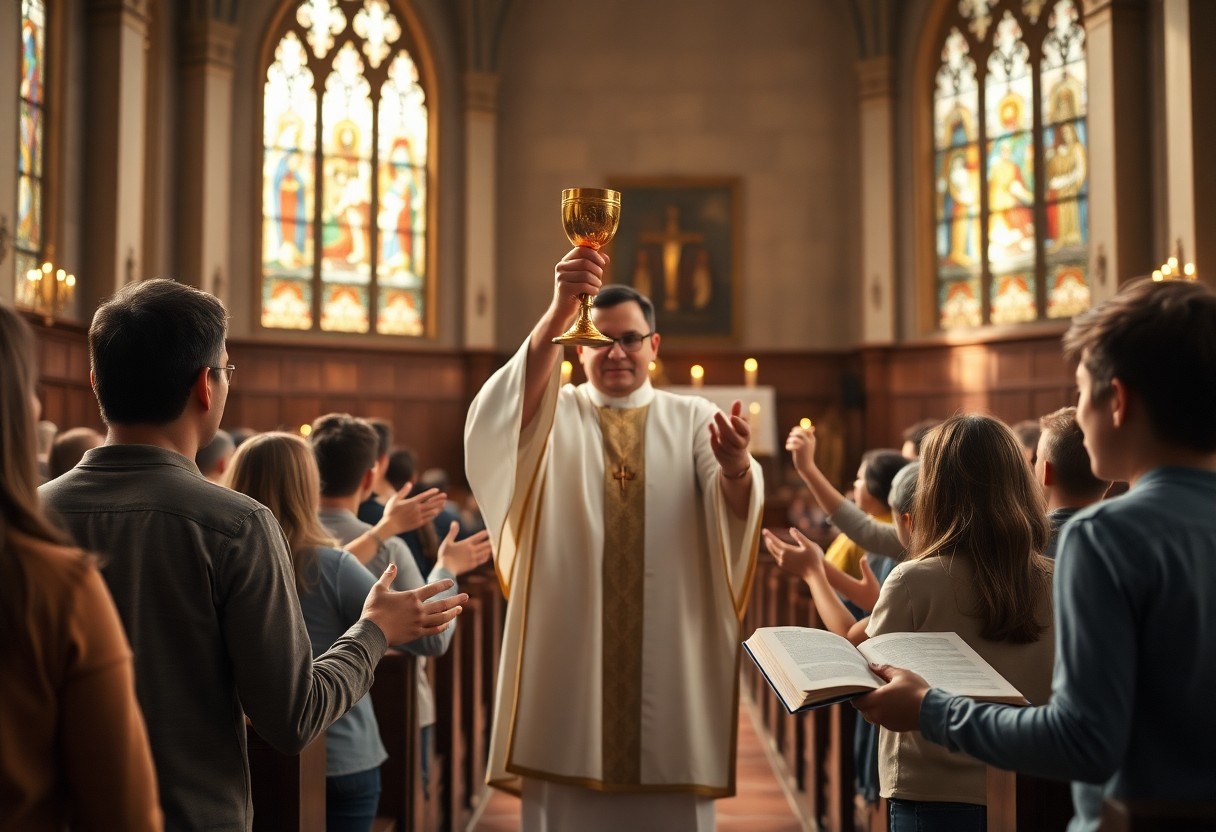
Just as many young Catholics were drifting from the Church, the Eucharist has emerged as a powerful force pulling them back. You’re not alone if you’ve felt a deep hunger for something real-this sacrament offers a tangible encounter with Christ that resonates in a distracted, digital age. Its mystery, reverence, and spiritual nourishment are proving transformative.
Key Takeaways:
- Young Catholics are rediscovering the Eucharist as a source of real presence and spiritual intimacy, drawing them back to regular Mass attendance and deeper participation in parish life.
- Parishes and campus ministries that emphasize Eucharistic adoration, clear teaching, and reverent liturgy are seeing increased engagement among younger generations.
- For many young people, the Eucharist stands out as a counter-cultural anchor-offering meaning, mystery, and community in a fragmented digital age.
The Weight of the Real
You’re tired of simulations. After years of curated feeds and pixelated interactions, something in you longs for substance-something that cannot be scrolled away. The Eucharist answers that ache with physical presence, not metaphor. This is not symbolism dressed as reality. This is Christ truly given, body and blood, soul and divinity, in a form you can hold, taste, and receive.
Rejection of the digital ghost
Another filtered image won’t heal your loneliness. You’ve seen how digital connection often deepens isolation, replacing touch with tags, presence with posts. The Eucharist refuses that illusion. It offers no avatar, no algorithmic echo-only the real presence of God, unmediated and unedited, standing in stark contrast to the hollow glow of the screen.
The solid comfort of the Sacred Host
That small white disc holds more weight than any digital declaration. You can’t double-tap it, but you can receive it-and in doing so, feel the quiet certainty of divine nearness. It doesn’t flicker or fade. It remains, like grace itself, steady and silent, offering peace no notification ever could.
What makes the Sacred Host so transformative is its tangible constancy. While the world shifts beneath your feet, this one thing stays unchanged-consecrated, offered, real. You don’t just believe in it abstractly; you encounter it with your senses. That moment of reception becomes an anchor, a physical promise that God is not distant, not theoretical, but here, now, in your hands and on your tongue.
The Ancient Adventure
History pulses beneath your fingertips every time you step into a church for Mass. This is no stale ritual but a living journey that has shaped empires, inspired artists, and sustained saints through fire and famine. You’re not just attending a service-you’re joining a 2,000-year-old mission that still breathes with divine urgency.
Seeking a compass in the modern fog
Confusion swirls around you-endless opinions, shifting identities, moral quicksand. In the Eucharist, you find something unchanging: a fixed point of truth that doesn’t bend to culture or trend. Here, in the quiet reverence of the altar, you’re not lost. You’re found.
The wild romance of the liturgy
Love here is not soft or sentimental-it’s fire, sacrifice, and surrender woven into every gesture. You kneel not out of obligation, but because your heart recognizes a lover’s presence in the bread. This is romance that defies logic, ancient and intoxicating.
Ritual becomes revelation when you realize each movement-genuflecting, crossing yourself, receiving on the tongue-whispers a sacred story. The incense, the silence, the consecrated host: these aren’t relics of a bygone era but signs of a God who woos you bodily. In a world of fleeting connections, the liturgy offers a love that demands everything and gives itself completely.
The Quiet Mutiny
You’re not the only one who’s noticed the shift-empty pews are filling again, not with loud proclamations, but with silent reverence. A new generation is reclaiming the Eucharist not as ritual, but as resistance. In a world that demands constant noise, your stillness becomes defiant.
Silence as a protest against noise
Stillness unsettles the modern mind trained on endless input. Your choice to sit in silence before the Eucharist is not passivity-it’s a rejection of the chaos that claims your attention. In that quiet, you declare that some things are too sacred to rush.
The subversive act of Adoration
Adoration disrupts the logic of productivity. You kneel not to achieve, but to be present. In a culture that measures worth by output, your silent vigil becomes a radical statement: God is here, and that is enough.
Adoration draws you into a rhythm older than efficiency, deeper than performance. You’re not solving a problem or broadcasting a message-you’re simply letting the Real Presence reshape your heart. That act, so gentle and so firm, undermines the values of a world built on distraction and self-promotion. In the dim light of the chapel, you find a dangerous peace-one that changes everything.
The Bread of the Brave
You find strength where others see only bread. The Eucharist is not a symbol for the timid-it’s the food of those who dare to believe in a God who hides in plain sight, who comes not in power but in humility. This is the meal of courage, offered to all who will receive it.
Nourishment for the spiritual exile
You’ve wandered, searching for meaning in places that left you emptier than before. The Eucharist meets you in that ache, not as a ritual obligation but as a homecoming. It speaks to the part of you that longs to belong, offering a presence that doesn’t demand perfection-only your honesty.
The feast that defies the clock
You live in a world that never stops moving, where everything feels temporary. The Eucharist stands outside time, a feast where past, present, and future collapse into one holy moment. Here, you’re not rushing toward the next thing-you’ve already arrived.
Time bends at the altar. The same sacrifice offered on Calvary renews itself in every Mass, not as a reenactment but as a participation. You are not merely remembering Christ-you are with Him, drawn into a mystery where eternity touches the now. This timeless reality offers stability in a fractured age, anchoring you to something unchanging and true.
The Paradox of the Pew
You’re told the Eucharist divides, yet it’s drawing young Catholics back in surprising numbers. While a political document on the Eucharist will push young people away, many are discovering its depth beyond partisanship-finding in the ancient rite a refuge from polarization.
Finding the future in the past
Time reveals what feels old can be profoundly new. You encounter in ancient liturgies a stability the modern world lacks. The very traditions some dismiss as outdated are becoming doorways for your generation’s return, offering a sacred rhythm that speaks directly to restless hearts.
The youth of an eternal Church
Age doesn’t measure the Church’s vitality-faith does. You belong to a communion where saints centuries gone still shape your prayer. Though the institution is ancient, its life flows into every young person who kneels at the altar, making each Mass a renewal of timeless youth.
That sense of eternal youth isn’t symbolic-it’s sacramental. Every time you receive the Eucharist, you’re not just remembering Christ; you’re being drawn into His risen life, which knows no decay. The Church may have old stones and older rites, but its heartbeat is perpetually fresh, sustained by a mystery that defies time.
Conclusion
Following this revival of interest, you see the Eucharist not as a ritual but as a personal encounter. You are drawn by its mystery, its call to presence, and its power to connect you with God and community in tangible ways. This sacrament meets your longing for meaning, belonging, and authenticity in a fragmented world.
FAQ
Q: Why are more young Catholics returning to church over the Eucharist?
A: Many young Catholics feel disconnected from modern culture and are searching for meaning, presence, and authenticity. The Eucharist offers a tangible encounter with Jesus that social media, technology, and secular institutions cannot replicate. For them, receiving the Body and Blood of Christ is not symbolic-it’s a real, personal meeting with God. This belief in the Real Presence draws them back to Mass, even when other aspects of church life feel distant or outdated.
Q: How does the Eucharist differ from other spiritual practices young people explore?
A: Unlike meditation, mindfulness, or non-denominational worship, the Eucharist is rooted in a 2,000-year-old tradition of sacramental belief. Young people who return often say they were drawn by the depth of continuity and mystery. They’re not just seeking peace or community-they want truth they can touch. The Eucharist provides a physical center to faith, something they can receive, not just feel. That tangible reality stands out in a world full of fleeting experiences.
Q: Are young Catholics staying in the Church because of the Eucharist alone?
A: The Eucharist is rarely the only reason, but it’s often the anchor. Many young people still struggle with Church teachings, institutional scandals, or rigid language. Yet when they experience the Eucharist as a personal gift of love, they’re willing to stay and wrestle with the hard parts. Parishes that emphasize reverence, silence, and beauty in liturgy often see deeper engagement. The sacrament becomes a starting point, not the finish line.
Q: What role do Eucharistic adoration and perpetual chapels play in this revival?
A: Eucharistic adoration offers a quiet, personal space that resonates with young adults facing anxiety, isolation, and constant noise. Perpetual adoration chapels, like those at Benedictine College or in dioceses such as Charlotte and Austin, have become hubs for student faith. Young people describe these places as “safe” and “real,” where they can sit with God without performance or pressure. The simple act of being near the Eucharist helps them feel known and grounded.
Q: How are parishes adapting to welcome these returning young Catholics?
A: Many parishes now offer traditional Latin Masses, extended adoration hours, and young adult ministries centered on Eucharistic spirituality. Homilies increasingly focus on the mystery of the Real Presence rather than moral lectures. Music, art, and architecture are being reimagined to reflect reverence. The shift isn’t about entertainment-it’s about creating spaces where awe can grow. Young people respond when the Church treats the Eucharist as the source, not just a ritual.