
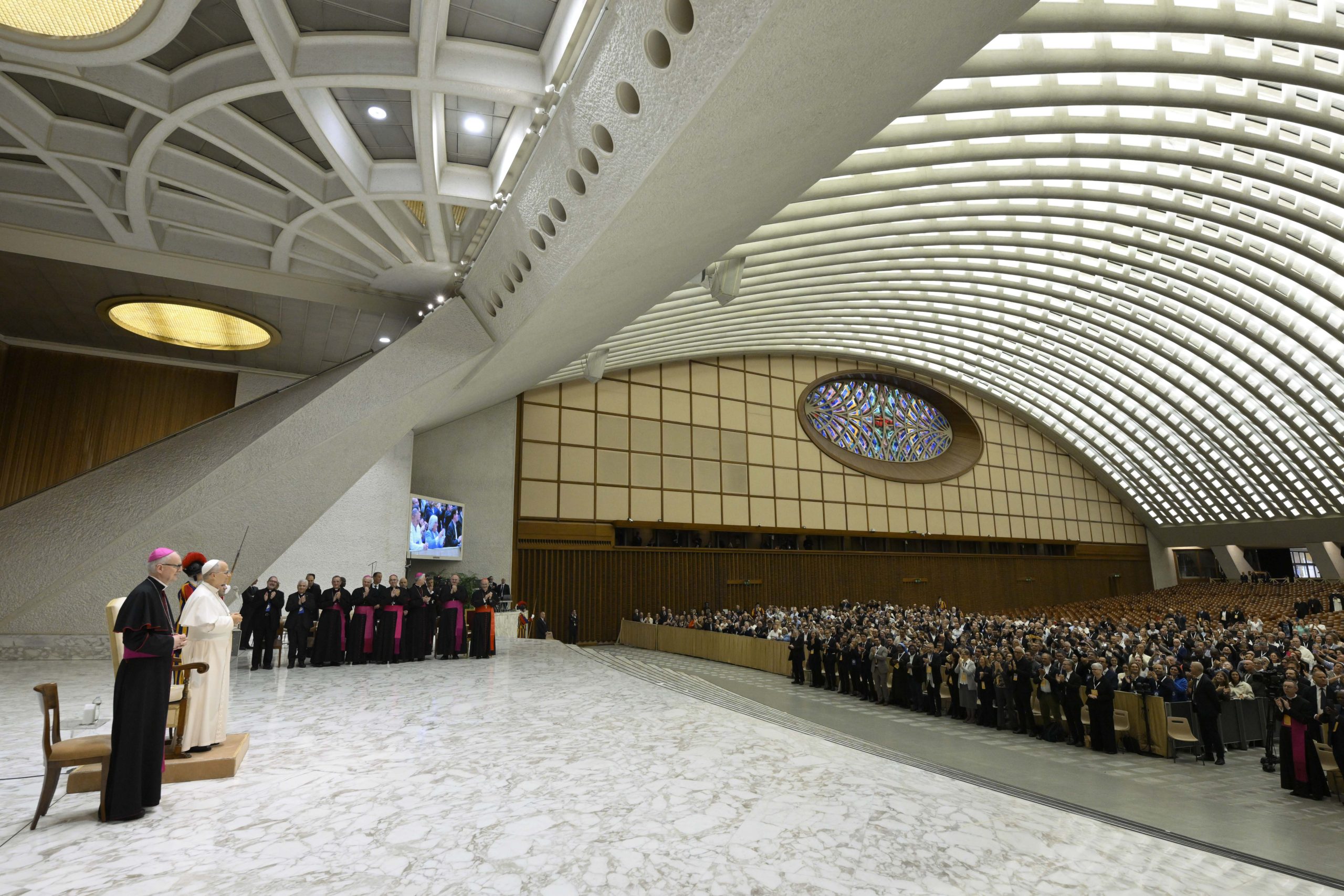
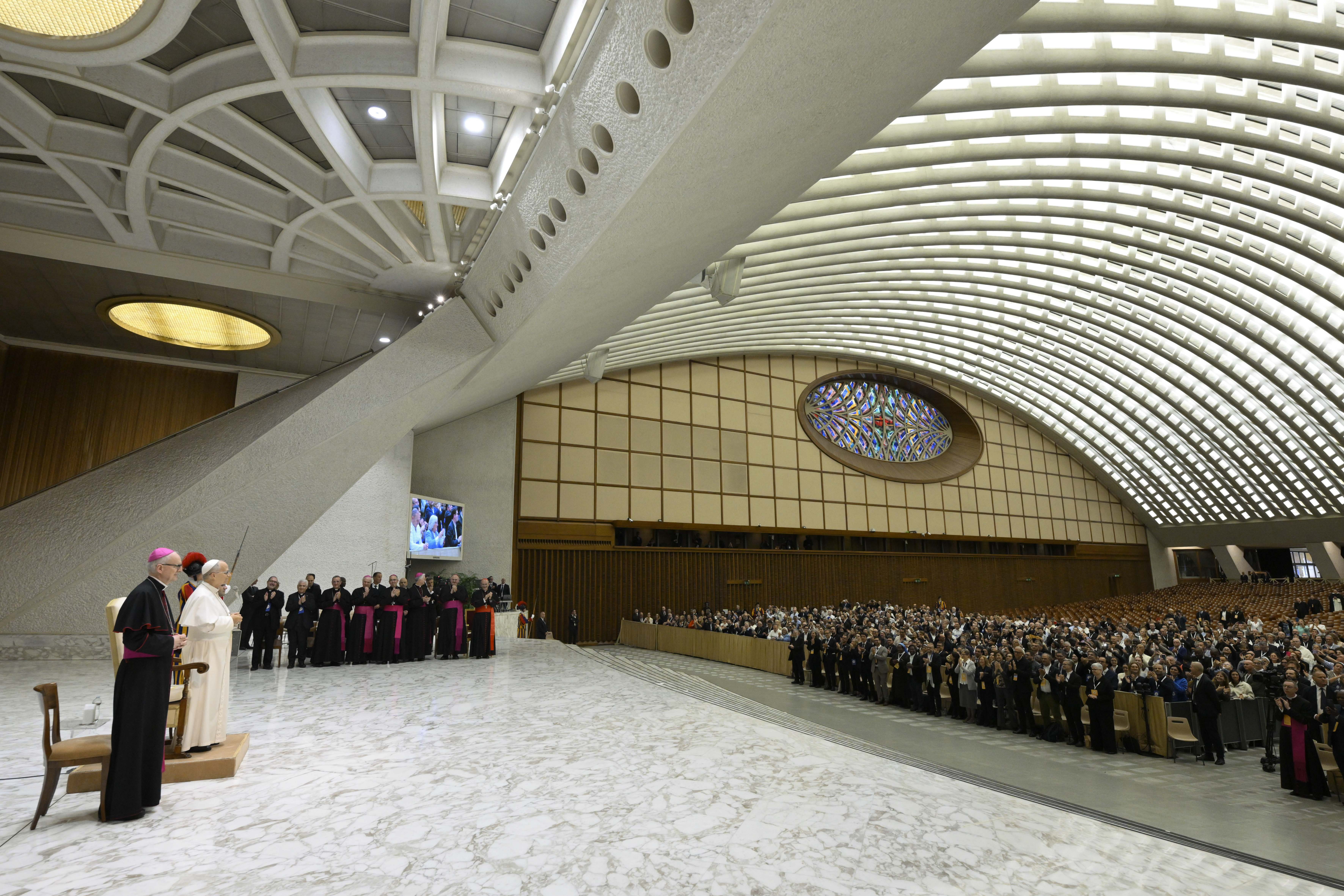
Pope Leo XIV on Thursday encouraged those involved in Catholic school and university pastoral ministry to respond to a “merciless” culture, which constantly compares and ranks young people, with the trust of Christ, capable of transforming lives just as it transformed the Twelve Apostles.
“Jesus did not choose the Twelve because they were already courageous; he called them and, through his trust, made them capable. To our young people we must be able to repeat the words the disciples addressed to the blind Bartimaeus: ‘Take heart; get up, he is calling you,’” the pontiff said in a message addressed to participants in the International Congress on School and University Pastoral Ministry, which concludes Friday, Oct. 23, in the Paul VI Audience Hall.
The gathering, organized by the Vatican’s Dicastery for Culture and Education, brings together 1,200 participants from 60 countries and is inspired by the apostolic letter “Charting New Maps of Hope,” the first apostolic letter of Pope Leo XIV. In it, he proposes a new phase of education built on three pillars: cultivating interiority, promoting a humane and rational use of digital technologies, and educating for peace.
“Help the young people you encounter become protagonists of a new way of inhabiting the world, builders of fraternity and of a more just society. Courage is born from a covenant of trust: from the experience of someone believing in you before you believe in yourself,” the Holy Father said.
Digital loneliness and feelings of inadequacy
Leo XIV warned that many students today face situations of suffering marked by “wounded families, digital loneliness, feelings of inadequacy, or fear of a future that seems uncertain.”
“We live in a culture of performance that constantly compares and ranks, sometimes mercilessly. A misunderstood meritocracy ends up failing to respect the dignity of persons,” he warned.
For this reason, he stressed the importance of educational institutions being, above all, “a home, a familiar place where one is expected.”
The pope also emphasized that the proper mission of education is the shared search for truth and encouraged educators to value young people’s questions and foster an encounter between faith and reason: “May your passion be to help young people experience the beauty of an encounter with Christ, as well as the fruitfulness of the synergy between faith and reason.”
Leo XIV also invited participants to focus their efforts on the integral formation of young people, especially in educating their emotional life and interior life.
“School and university pastoral ministry will be all the more fruitful the more it is centered on the education of the heart,” he said. In this regard, he encouraged the promotion of compassion, gratitude, sensitivity to the suffering of others, and openness to God, recalling that “charity and prayer are inseparable.”
In closing, the pope compared the educational mission to Jesus’ accompaniment of the disciples on the road to Emmaus and urged teachers, chaplains, and pastoral workers to walk alongside young people and help them discover the gifts God has placed within them.
“You have chosen to do something much greater: to walk with them along the way until they discover the gifts God has already placed within them,” he concluded.
‘Revival driven by Leo XIV’
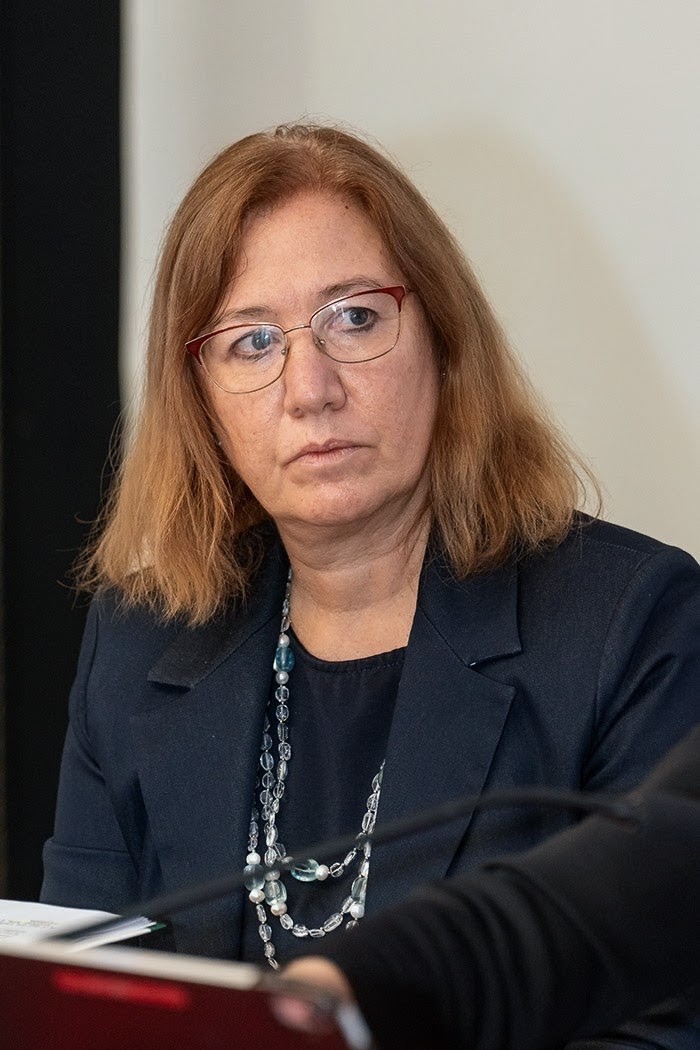
Among those taking part in the Vatican gathering is Carina Rossa, a member of the coordinating committee of the Global Compact on Education.
According to Rossa, who is from Argentina, one of the most significant aspects of the congress is the renewed attention the Holy See is giving to educational pastoral ministry, an area that, she explained, until now did not have a dedicated structure within the Dicastery for Culture and Education.
“Educational pastoral ministry is experiencing a revival driven by Leo XIV,” she said. “It is an area that is the heart of the university and the heart of the school.”
She recalled that the Global Compact on Education was launched by Pope Francis in 2020 and highlighted the importance of Leo XIV’s decision to take it up again and relaunch it during the Jubilee of the World of Education in 2025.
“The fact that Pope Leo relaunched the Global Compact on Education has been very important in revitalizing this proposal,” she said. According to Rossa, universities and educational institutions in different parts of the world have shown renewed interest ever since. “There is a need for, and a new enthusiasm about, this project.”
3 priorities for Catholic education
Rossa noted that the congress is centered on three major goals identified by Leo XIV: cultivating interior life, promoting a humane use of digital technologies, and educating for peace.
In particular, she emphasized the importance of recovering the spiritual dimension of education in a context marked by a crisis of meaning and mental health challenges among young people.
“What is emerging strongly is a great desire for meaning, interiority, spirituality, and silence,” she said. “We appreciate that Pope Leo speaks about this from his Augustinian charism, but above all because he does so in light of listening to young people,” the Global Compact on Education representative said.
She explained that in recent years the initiative has gathered testimonies and concerns from young people in different countries.
While she sees among them a strong social commitment and a desire for an integral education, she believes there is an even deeper need.
“St. Augustine reflects today’s young person very well, searching everywhere until discovering that God was within him all along,” she said.
A pastoral ministry that transforms academic life
For Rossa, educational pastoral ministry should not be understood as a parallel activity or one limited to religious celebrations but as a dimension capable of transforming the entire life of an academic institution.
“It is not something isolated, nor is it only about celebrations,” she explained. “It can revitalize the way we teach, the way we relate to students, the way the university connects with its local community, or how it approaches questions such as care for creation, the search for truth, beauty, and culture.”
After only the first day of the congress, the Argentine highlighted the high quality of the presentations and the atmosphere among participants.
“There is a lot of enthusiasm,” she said. “The 1,200 people gathered here are not only listening but are creating a true community among pastoral workers from different parts of the world.”
Unexpected encounter with the pope
One of the most moving moments of the congress was the encounter with Leo XIV, which had been on the schedule for weeks but had been thrown into doubt because of his recent lung cancer surgery, from which he is gradually recovering.
“It was very moving because we were not expecting it,” Rossa recounted. “Given his health situation, it seemed to me a very generous gesture on his part.”
After his address, Leo XIV personally greeted several of the speakers and participants.
This story was first published by EWTN News Español, the Spanish-language sister service of EWTN News. It has been translated and adapted by EWTN News English.