

“We wanted to make sure that it was an epic-looking building” with an interior that would raise hearts and minds “to the beauties of heaven,” he said.
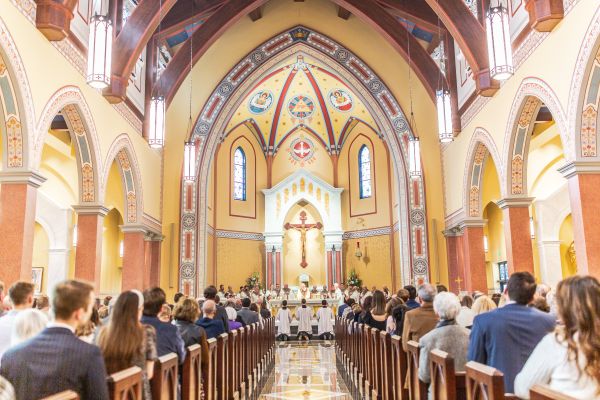
Given her involvement in the community and her interest in beauty and design, Hammerschmidt asked Gorges to serve on the building committee, which meant she would have a say in the church’s aesthetic. Gorges said she was invited to help design the church’s tile flooring. She researched churches online for inspiration and also drew from her personal experience of visiting numerous beautiful sacred spaces on a trip to Italy.
Ridge Pinkston, a fifth-year senior when CNA spoke with him, studying medieval history, was also chosen to be on the building committee. He told CNA that the committee — which included Hammerschmidt, diocesan board member Doug Hinkin, and others — was given almost complete control over the look of the new church.
He said the committee had numerous meetings with the architect to figure out the look of everything in the new church — they spent an entire two-hour meeting designing the look of the altar, for example. He said the building committee “represented the body of owners” to the architect and designers, similar to how when a family builds a house, the architects and contractors consult them on how they want it to look. He said it was a “huge privilege” and a great learning process to be a part of the committee as a student.
Despite his interest in medieval architecture, the churches that Pinkston primarily drew inspiration from were mainly stateside; most are located in the Archdiocese of Denver. They included the medieval revival-style chapel at St. John Vianney Theological Seminary and the Cathedral Basilica of the Immaculate Conception and Holy Ghost Catholic Church, both in downtown Denver.
Ultimately, the architects and designers of St. Isidore’s produced a neo-Gothic interior with pointed arches that dropped many a jaw when it was unveiled. The interior also features numerous instances of vine imagery — an image of Jesus himself, but also a subtle nod to the college’s agricultural heritage. Evergreene Architectural Arts, a renowned design studio in New York, provided the decoration, Hammerschmidt said.
Not everything in the interior is entirely new, however. Hammerschmidt said at the request of students, stained-glass windows depicting the seven patron saints of the seven original colleges at Kansas State (the university was originally Methodist-founded) were saved and incorporated into the new church. Among those saints are the church’s namesake, St. Isidore — an 11th-century Spaniard and patron saint of agricultural workers — as well as the namesake of the student center, St. Robert Bellarmine. A much-loved crucifix that hung over the tabernacle in the old church was also used again in the new church.
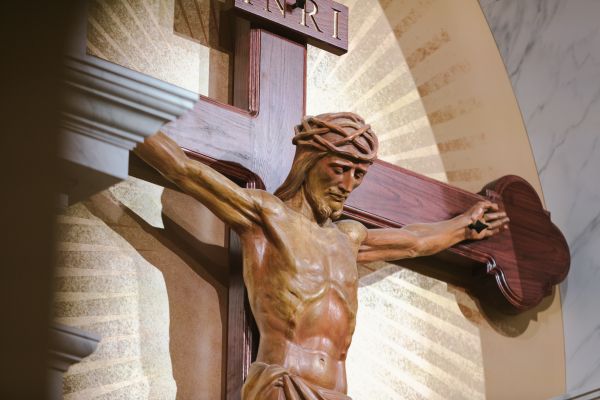
Gorges said she loves the triumphal arch over the altar in the finished church, which draws one’s eyes toward the focal point of the crucifix, and onward to heaven. A beautiful church, she said, is “not the end-all-be-all by any means. But if it’s at all possible, beauty matters. And we should be trying to live that in our daily lives.”
Pinkston said his favorite design element in the new church, apart from the ceiling of the apse, is the new altar itself, which he said really strikes him as being designed in a way that calls to mind a place where sacrifices are made.
(Story continues below)
Subscribe to our daily newsletter
“Rightfully, that should be one of the most beautiful features,” he said of the altar.
The designers also took care to design the exterior of the church to match the native limestone buildings of Kansas State, in an effort to make the church an integral part of the campus it serves.
Bishop Gerald Vincke of Salina, Kansas, dedicated the diocese’s newest church on Jan. 28. The 14,000-square-foot structure can accommodate about 700 for Sunday Masses.
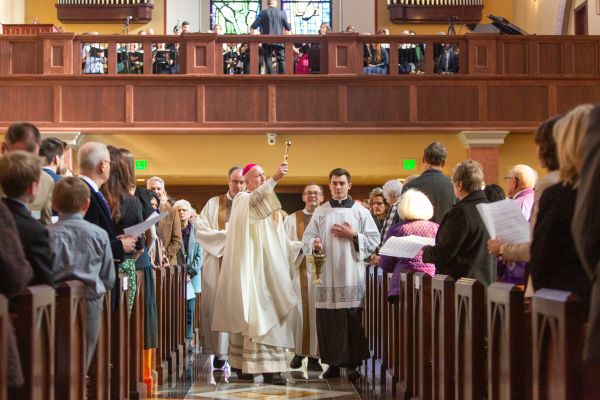
Hammerschmidt said daily Masses at St. Isidore’s were already attracting nearly 200 students on a regular basis. A key part of the Catholic center’s success, he said, is the presence of missionaries from the Fellowship of Catholic University Students (FOCUS). FOCUS maintains a presence on college campuses with the goal of winning people to the Catholic faith through authentic friendships and forming others to go out and do the same through Bible studies, small groups, and retreats.
“We also work closely with the high schools in the state of Kansas, especially the Catholic high schools. And we have many strong Catholic high schools in our area. And so we just have students who, the first day they show up in Manhattan, they already know about us,” Hammerschmidt said.