
‘Deep study’
Throughout the years, at least 7,000 people have reported experiencing supernatural healings at Lourdes, but a mere 70 of those cures have been recognized by the Catholic Church as miraculous — the latest, which took place in 2008, was declared in 2018.
Alessandro de Franciscis, president of the Lourdes Office of Medical Observations, is charged with investigating each claim of a miraculous cure — a task he does not take lightly. The local bishop of the Diocese of Tarbes and Lourdes appointed de Franciscis to his role in 2009.
“We scrutinize and study an alleged cure with very deep engagement and with very strict criteria,” the Italian medical doctor told CNA.
“This is the only religious institution — not in the Catholic world, in all religions put together — in which there is such a precise and thorough, deep study of the alleged cure.”
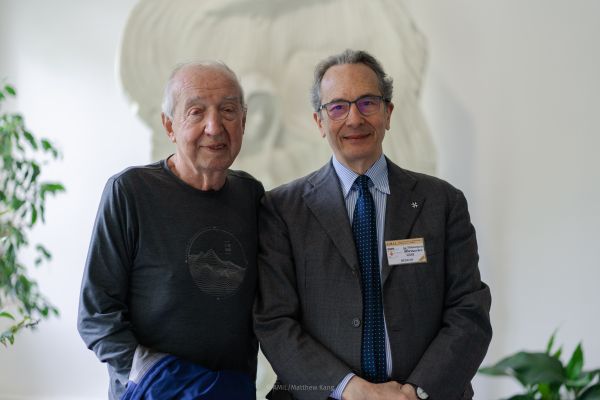
The Office of Medical Observations was created in 1883 to study all the alleged cures that were being reported at Lourdes. The criteria for the investigation of an alleged miraculous cure are numerous, and involve the investigation of whether the ailment was medically diagnosed with a severe prognosis, and whether the cure was instantaneous, lasting, and unexplainable by normal scientific means.
The rigor of the scientific investigative process is borne out by the fact that out of the thousands of alleged cures de Franciscis and his team have personally investigated, just three have been declared miraculous during his tenure.
De Franciscis, a practicing Catholic, said the healings at Lourdes have a way of capturing the imaginations of people of all faith backgrounds, just as the healings that Jesus himself did in the Gospels drew people to him and demonstrated his power.
“The one thing I learned in these 13 years of residency in Lourdes is that sometimes you have to lift up your hands and say, ‘This I do not understand,’” de Franciscis said.
“In the world, in our experience of faith, you cannot explain everything rationally. And there are things we cannot explain that are part of the treasure of our faith. I think that in the pilgrimage, to Lourdes as in any other place of pilgrimage, and in the cures of Lourdes, there is a strong evangelizing meaning.”
(Story continues below)
De Franciscis first came to Lourdes as a teenager to volunteer in the same role that the now-healed Micheli performs to this day, as a brancardier, or stretcher-bearer. His experience serving the sick and the handicapped at Lourdes helped to inspire him to become a physician.
“As a young volunteer in Lourdes, I was part of those who found that there was an injustice, why a few were cured, and so many others not,” de Franciscis admitted.
“The cured persons of Lourdes that I have met, instead told me the opposite. They would say, ‘Why me and not someone else?’ So it is very clear that each of us lives [our] own Christian path in a different way … Everyone leaves from Lourdes, not necessarily physically cured, but certainly with new hope and new strength in their hearts,” the doctor said.

Jonah McKeown is a staff writer and podcast producer for Catholic News Agency. He holds a Master’s Degree from the University of Missouri School of Journalism and has worked as a writer, as a producer for public radio, and as a videographer. He is based in St. Louis.