

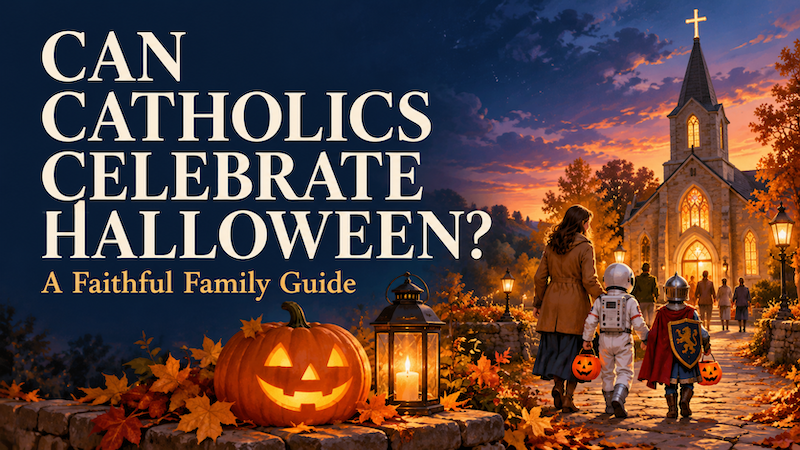
The school sends home a party announcement. Your child wants a costume. A friend insists that no Catholic should participate in Halloween.
Suddenly, a simple family decision becomes a question about faith.
Catholics can take part in Halloween customs that are consistent with Christian faith and morality. Dressing up, sharing treats, and enjoying a neighborhood gathering are not the same as participating in occult practices. Catholic Answers, for example, explicitly affirms that Catholics can celebrate Halloween appropriately. www.catholic.com
The most useful question is what your family will actually be doing—and what those choices communicate.
What does Halloween have to do with Catholicism?
The name Halloween comes from All Hallows’ Eve, the evening before All Saints’ Day on November 1.
That connection provides a Christian setting for remembering holiness, the communion of saints, and the hope of eternal life. November 2 then brings All Souls’ Day, when Catholics pray for the faithful departed.
Present-day Halloween customs have a varied history. It is more accurate to examine particular customs than to describe everything associated with Halloween as entirely Catholic or entirely pagan. focus.org
For families, this means October 31 can become an opportunity to explain the days that follow.
Ask your children: “Who is a saint you would like to learn about?” Let the conversation reach beyond the costume.
Is trick-or-treating a sin?
Ordinary trick-or-treating is not inherently an act of worship or an occult practice.
Parents should consider the actual circumstances: the child’s age, the setting, supervision, the content of an event, and how participants treat one another.
A child collecting sweets in an astronaut costume is doing something different from attempting to summon spirits.
Families may also choose an All Saints party, a parish gathering, or a quiet evening at home. Different reasonable choices do not need to become a contest over which household is more faithful.
The aim is to make a thoughtful decision and explain it calmly.
What should Catholics avoid?
The Church’s clearest boundaries concern real practices, rather than a calendar date.
The Catechism rejects divination, attempts to conjure the dead, and practices intended to control occult powers. See CCC 2116–2117. Those teachings apply throughout the year, including Halloween. www.vatican.va
For a family, that means declining activities such as séances or fortune-telling presented as a way to obtain supernatural knowledge.
A helpful explanation for children is:
“We can enjoy make-believe. We do not try to contact spirits or seek hidden powers.”
If you are unsure what an event includes, ask the organizer. The description of the actual activity matters more than whether it is advertised as “just for fun.”
How should Catholic parents choose costumes?
There is no need to invent a universal Church-approved costume list.
Instead, apply ordinary moral judgment. Ask whether a costume:
- Treats people with dignity.
- Avoids mocking the sacred or ridiculing a vulnerable person.
- Is appropriate for the child’s age.
- Avoids sexualized content or the celebration of cruelty.
- Fits the setting in which it will be worn.
Saint costumes can be a joyful way to learn about the faith. Children can also enjoy many ordinary costumes without pretending that every playful activity must become a religious lesson.
For ambiguous choices, invite conversation. “What do you like about that character?” may reveal that a child admires courage or imagination rather than the troubling element a parent noticed.
What about frightening decorations and haunted attractions?
Families can reasonably differ about mild pretend scares. Parents should consider what a child can comfortably handle and what a particular attraction depicts.
Before attending, look beyond the event’s name. Is it playful make-believe, intense horror, graphic cruelty, or an activity involving actual occult practices?
If your child is frightened, listen. Do not insist that they prove their bravery.
You can also set a household boundary without making exaggerated claims about what will happen to someone who chooses differently. Clear explanations build better judgment than panic.
A simple Catholic plan for October 31–November 2
Here is one way to connect family enjoyment with the Church’s calendar:
Before Halloween: Choose activities together. Explain any boundaries before the evening arrives.
On October 31: Practice hospitality. Thank neighbors, include someone who might otherwise be left out, and share generously.
On November 1: Attend Mass for All Saints and learn about a saint as a family. In 2026, November 1 is a Sunday. www.usccb.org
On November 2: Pray for deceased relatives and friends. If possible, visit a cemetery respectfully or arrange a Mass intention through your parish.
Keep the plan manageable. A short prayer offered attentively is better than a complicated program that leaves everyone exhausted.
Frequently asked questions
Must Catholic children dress as saints?
No general Church rule requires a saint costume for ordinary Halloween activities. A parish or school event may have its own theme or requirements.
Is carving a pumpkin an occult practice?
Carving a decorative pumpkin is not, by itself, an attempt to invoke spirits or obtain supernatural power. Consider its actual use and meaning rather than assuming the object determines the morality of the activity.
Can we skip Halloween entirely?
Yes. Families can choose not to participate. That decision can be made peacefully without condemning families who choose appropriate celebrations.
Is praying for the dead the same as trying to contact them?
No. Prayer for the dead entrusts them to God. Attempting to summon or consult spirits is a different practice and falls under the Church’s rejection of divination. www.vatican.va
Give children clarity, not fear
Halloween can be an occasion to teach discernment: how to enjoy something, recognize a boundary, and treat other people well.
A Catholic family can make room for laughter and imagination while remaining clear about the faith.
Choose your activities thoughtfully. Explain your reasons. Then help your children see that the days ahead point toward something greater than costumes: holiness, prayer, and hope in Christ.
What tradition helps your family connect Halloween with All Saints’ Day?