

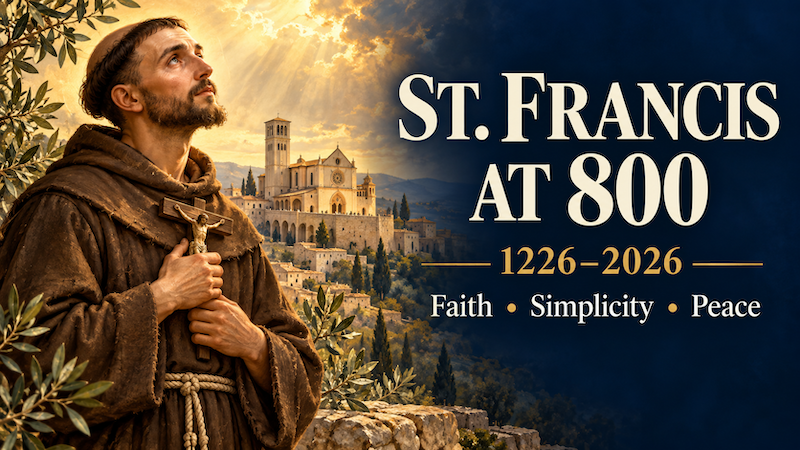
Many of us recognize St. Francis of Assisi immediately: the brown habit, the birds, the peaceful figure standing in a garden.
But a familiar image can become so comfortable that we stop listening to the person behind it.
In 2026, the Catholic Church commemorates 800 years since St. Francis’s death in 1226. The anniversary invites Catholics to look again at a man whose love of Jesus changed his relationship with possessions, suffering, other people, and creation.
Celebrations in Assisi culminate around his October 4 feast day, with the commemoration of his passing—the Transitus—forming part of the anniversary observances. www.vaticannews.va
The question for us is personal: what would it mean to take the Gospel as seriously in our circumstances as Francis did in his?
What is the 800th anniversary of St. Francis?
The anniversary commemorates St. Francis’s death, rather than his birth or canonization.
Franciscans use the word Transitus, meaning passage, for the remembrance of his passing from this life to God. The annual observance takes place on the evening of October 3, before his feast on October 4. The 2026 commemoration marks eight centuries of his continuing influence. ofm.org
An anniversary can preserve a memory. It can also interrupt our routines.
We might admire Francis’s simplicity while struggling to stop buying things we do not need. We might praise his peacefulness while rehearsing an argument in our minds. We might love the image of his kindness while avoiding someone whose suffering makes us uncomfortable.
That tension gives us somewhere honest to begin.
Why St. Francis is more than the saint of animals
Francis’s life was shaped by conversion and a desire to follow Jesus. The Franciscan account of his life describes his movement away from worldly ambition toward prayer, poverty, service, and brotherhood. His encounter with people suffering from leprosy was an important part of that transformation. ofm.org
This gives his familiar association with animals a deeper context.
When we write about Francis only as a gentle nature lover, we risk leaving out the demanding center of his life: following Christ.
His example asks more than whether we appreciate a beautiful landscape. It asks whether gratitude changes how we live, whether we recognize people we usually overlook, and whether our faith reaches beyond words.
What does Franciscan simplicity mean for an ordinary family?
Most Catholic families are not called to live exactly as Francis and his first brothers did. Parents have responsibilities: housing, food, education, savings, and care for dependents.
A useful application of his example is to examine what possessions are doing to our hearts.
Consider three questions:
- Am I buying this because it serves a real purpose, or because I feel inadequate without it?
- Is maintaining our lifestyle leaving us with little time for prayer and relationships?
- Could something we have in excess meet another person’s genuine need?
A family might choose one manageable response: donate useful items, reduce an unnecessary expense, or set aside money for direct assistance.
The purpose is not to perform simplicity for others. It is to become freer to love.
What can St. Francis teach us about peace?
The anniversary celebrations place renewed emphasis on peace, fraternity, and the continuing relevance of Francis’s Gospel witness. www.vaticannews.va
For most of us, peacemaking begins much closer than an international conflict.
It begins with the reply we are about to send. The family member we have reduced to their worst opinion. The apology we keep postponing because we want the other person to speak first.
Consider a practical exercise: before responding to someone who frustrates you, describe their concern in words they would recognize.
You do not have to agree. But you can refuse to humiliate them.
This approach also has a place in Catholic conversations online. Defending the faith does not require contempt for the person asking a question.
Four ways to mark the anniversary at home
1. Read a Gospel passage slowly
Choose a short passage such as Matthew 5:1–12. Ask each person to identify one teaching they find difficult to live.
2. Practice one concrete act of generosity
Offer help that responds to a real need. Ask a parish ministry what would be useful before deciding what to donate.
3. Make room for reconciliation
Offer a sincere apology where one is owed. Seek the sacrament of reconciliation when appropriate.
4. Turn appreciation into care
Take a family walk, notice the world around you, and choose a small act of stewardship. Let gratitude become something you do.
These are suggested ways to respond to the anniversary, rather than official requirements for observing it.
Frequently asked questions
Why is 2026 important for St. Francis?
It marks 800 years since his death in 1226. The anniversary offers an opportunity to revisit his witness and its meaning for the Church today.
When is St. Francis’s feast day?
His feast day is October 4. In 2026, that date falls on a Sunday, so the Sunday liturgy generally takes precedence in ordinary parish celebrations; particular Franciscan or local calendars may differ. www.usccb.org
Do I need to travel to Assisi to participate?
You can mark the anniversary through prayer, learning, parish activities, and concrete acts of charity wherever you live.
What should I read next?
Begin with an account of Francis’s life, then explore his writings and Franciscan explanations of his spirituality. Understanding the person helps us move beyond familiar images.
Let the anniversary change one habit
Eight hundred years later, Francis still offers us an uncomfortable and hopeful question: what would change if we allowed our love of Christ to shape more of our ordinary decisions?
You do not have to answer with a dramatic gesture.
Begin with one possession you can share, one person you can hear more patiently, or one responsibility you can carry with greater love.
Which part of St. Francis’s example challenges you most: simplicity, generosity, or peace?