
Over two billion Christians worldwide belong to the Catholic Church, and within its tradition, you encounter prayers directed to Mary and the saints. You may wonder whether this practice implies worship, but the Church teaches that such prayers are not acts of adoration, which is reserved for God alone. Instead, you ask saints to intercede, much like requesting prayer from a fellow believer. This distinction protects the integrity of divine worship while affirming the communion of all the faithful, living and dead.
Key Takeaways:
- Catholics do not worship Mary or the saints; worship is reserved for God alone, while the honor given to saints is veneration, a form of respectful admiration and imitation of their holy lives.
- Praying to saints is understood as asking for their intercession, much like requesting prayer from a fellow Christian, based on the belief that those in heaven remain united with the Church on earth.
- Mary holds a unique place in Catholic devotion due to her role as the Mother of Jesus and her complete openness to God’s will, making her a powerful intercessor and model of faith.
The Crucial Distinction of Devotion
You direct your worship exclusively to God-Father, Son, and Holy Spirit-understanding that only He is worthy of latria, the highest form of adoration. When you honor Mary or the saints, you offer dulia, a reverence given to holy people, not divine worship. This distinction safeguards the integrity of your faith, ensuring that intercession never becomes idolatry. A statue of St. Therese does not receive prayers as a god, but as a reminder of her spiritual legacy and closeness to Christ.
The Mechanism of Intercessory Prayer
When you pray to Mary or the saints, you are not invoking distant figures but asking for the spiritual support of those already in God’s presence. Their prayers carry weight, not because they possess divine power, but because their closeness to Christ amplifies their intercession. You participate in a communion where prayer flows both ways, and the saints, perfected in holiness, join their petitions with yours. This practice reflects a belief in the unity of the Church across heaven and earth, where love and prayer transcend physical death. Just as you might ask a friend to pray for you in a hospital room, Catholics ask saints to do the same from their place in glory.
The Great Cloud of Witnesses
You join a living communion when you pray through the saints, drawing near to those who walked the faith before you. They are not gods, nor are they mediators of salvation, but their lives testify to Christ’s transforming power. You honor them not as divine figures, but as members of the Church Triumphant, whose prayers strengthen your own. A mid-sized SaaS firm might rely on a network of support teams, yet you rely on a far greater network-the faithful across ages interceding in love.
The Visual Language of Faith
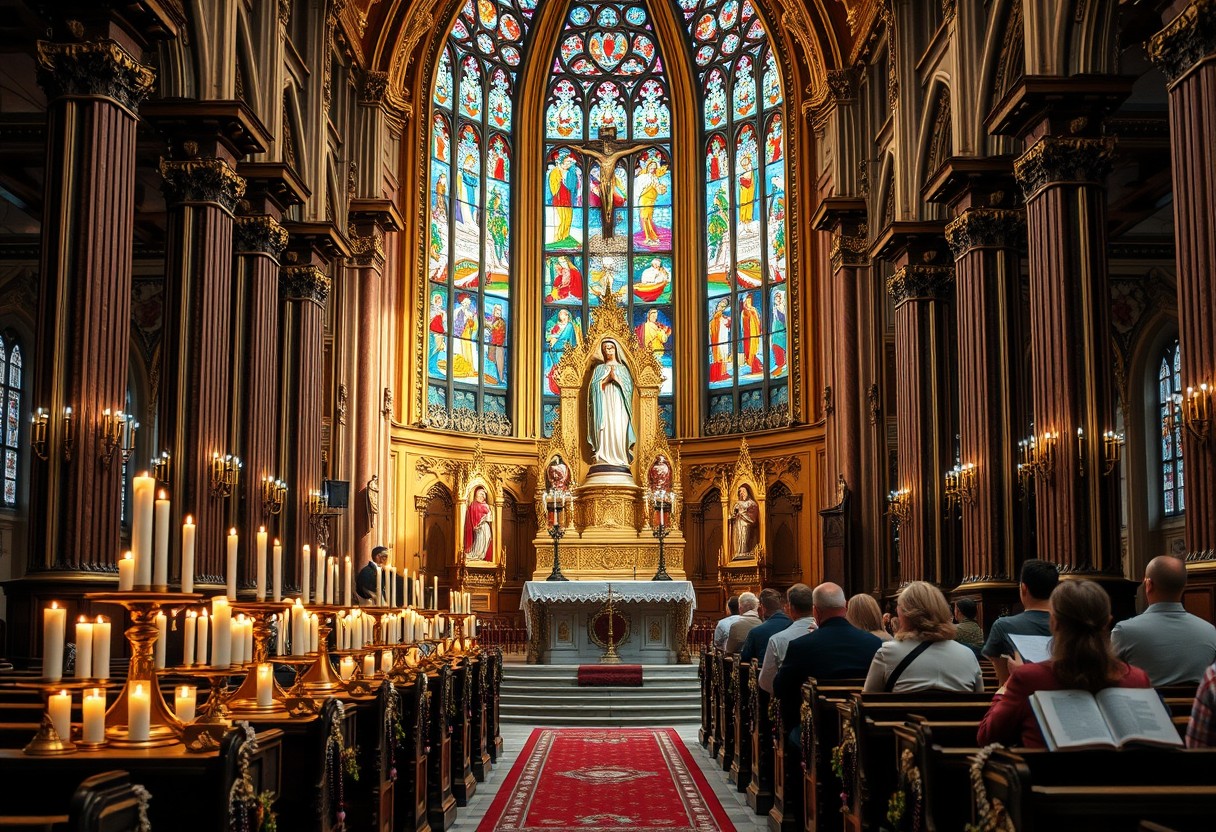
Icons, statues, and stained-glass images are not objects of worship but invitations to contemplation, directing your gaze beyond the visible to the holy lives they represent. You encounter Mary in art not as a distant figure but as one whose posture, gesture, and expression model receptivity to God. These images serve a pedagogical and spiritual function, embedding theological truths in form and color so that even the illiterate can grasp the dignity of the saints. When you kneel before an image, it is not the wood or paint you honor, but the heavenly reality it reveals.
Final words
You do not worship Mary or the saints when you pray to them; that honor is reserved for God alone. Instead, you ask for their intercession, much like requesting a friend to pray for you. Their closeness to God in heaven makes their prayers especially meaningful. You look to Mary not as a deity but as the first and most faithful disciple, whose ‘yes’ changed history. You honor the saints not to elevate them above others, but to recognize the grace of God working through human lives. Your prayers to them are not directed toward them as ends, but as channels pointing back to Christ. A Catholic lighting a candle before a statue of St. Therese is not worshipping stone or memory, but expressing trust in a spiritual friendship that transcends death.
FAQ
Q: Why do Catholics pray to Mary and the saints if Jesus is the only mediator between God and humanity?
A: Catholics believe that while Jesus Christ is the sole mediator of salvation, the saints, including Mary, participate in intercessory prayer as members of the Body of Christ. This practice does not diminish Christ’s unique role but reflects the communion of saints-a spiritual solidarity among believers on earth, in purgatory, and in heaven. Just as one might ask a friend to pray for them during a difficult time, Catholics ask the saints to intercede before God, trusting in their closeness to Him. The New Testament supports this understanding, as James 5:16 affirms that “the prayer of a righteous person has great power,” implying that the prayers of holy individuals, living or glorified, carry spiritual weight.
Q: Isn’t praying to Mary and the saints a form of worship, which would violate the First Commandment?
A: Prayer directed to Mary and the saints is not worship but veneration, a distinct form of honor. Catholics reserve worship-known as latria-for God alone. The honor given to saints, called dulia, and the special honor given to Mary, known as hyperdulia, are qualitatively different from divine worship. This distinction is reflected in Catholic liturgy and theology, where prayers to saints always conclude with appeals to God, such as “through Christ our Lord.” For example, the Hail Mary ends with a petition to God for mercy, not to Mary for salvation. The practice aligns with the biblical principle of honoring those whom God has exalted, as seen in the veneration of prophets and elders in Jewish tradition.
Q: Where in the Bible does it say we can ask the saints to pray for us?
A: While the Bible does not contain an explicit command to invoke the saints, it presents a vision of spiritual communion that supports the practice. Revelation 5:8 describes the saints in heaven offering “golden bowls full of incense, which are the prayers of the saints,” suggesting that heavenly beings are aware of and involved with earthly prayers. Similarly, Revelation 8:4 shows the prayers of the saints rising before God. Hebrews 12:1 speaks of believers being “surrounded by a great cloud of witnesses,” implying a spiritual connection between the faithful on earth and those who have gone before them in faith. These passages, interpreted within Catholic tradition, provide a scriptural foundation for seeking the intercession of the saints.
Q: Why is Mary given such a prominent role in Catholic devotion compared to other saints?
A: Mary holds a unique place in Catholic belief because of her divine motherhood, her sinless nature, and her perfect cooperation with God’s grace. As the Mother of Jesus, she is also honored as the Mother of the Church, a title affirmed by the Second Vatican Council. Her “yes” at the Annunciation reversed the disobedience of Eve, making her a pivotal figure in the story of redemption. Catholics point to Luke 1:48, where Mary prophesies, “all generations will call me blessed,” as a scriptural basis for her enduring spiritual role. Devotions such as the Rosary and the Litany of Loreto reflect her multifaceted intercessory presence, not as a divine figure but as the foremost intercessor among the saints.
Q: Do Catholics believe that Mary or the saints can answer prayers independently of God?
A: No, Catholics do not believe that Mary or the saints possess divine power or act independently. Any grace or response attributed to their intercession is understood to flow from God alone. When a Catholic prays to Saint Joseph for help finding a home, for instance, the belief is not that Joseph controls housing outcomes, but that he brings the request before God, whose will alone determines the outcome. This mirrors the way Paul and other apostles asked fellow Christians to pray for them, recognizing that even spiritual aid operates through God’s sovereignty. The saints are seen as powerful intercessors because of their holiness and proximity to God, not because they possess autonomous authority.