
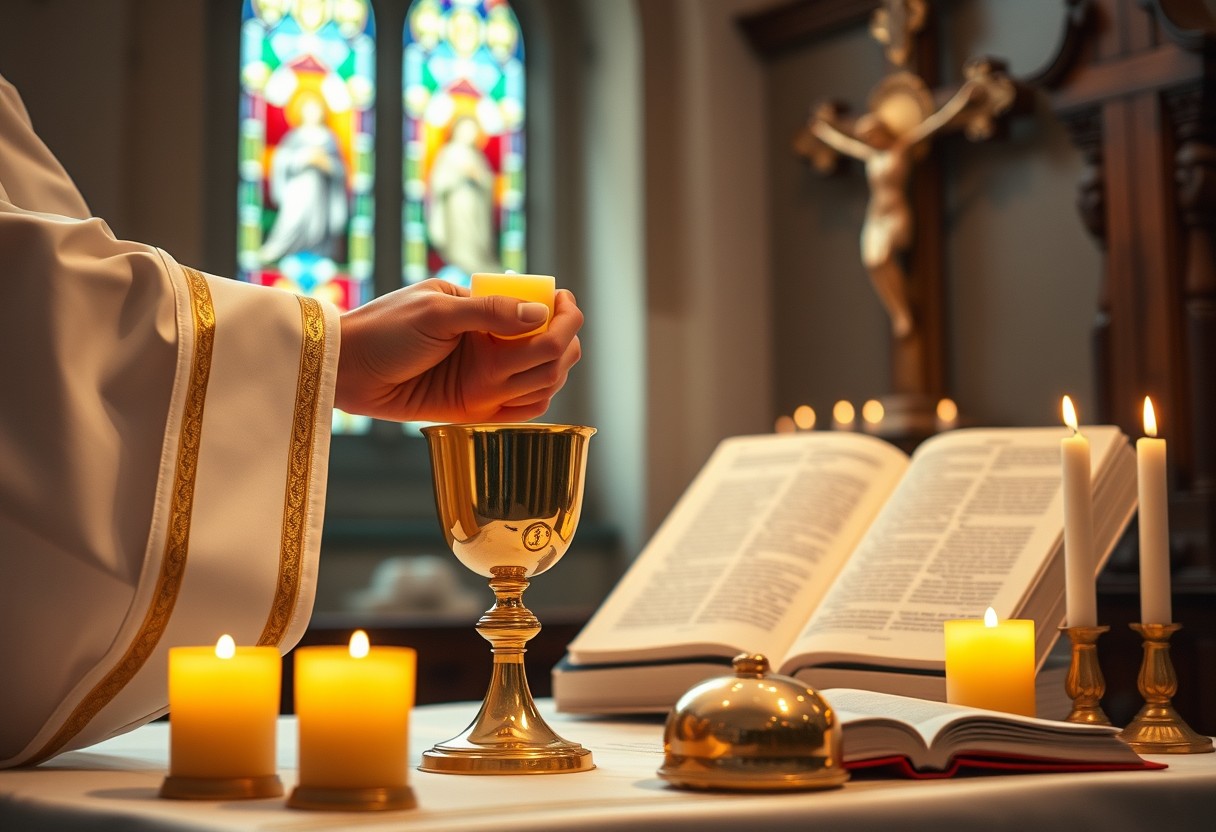
Most Catholics believe the bread and wine at Mass become the actual body and blood of Jesus Christ, not merely symbols. This conviction centers on the Real Presence, a doctrine so central that receiving Communion is considered a participation in the living sacrifice of Calvary. You encounter this mystery in every Mass, where ordinary elements are believed to transform in substance while retaining their appearance, a change the Church defines as transubstantiation.
Key Takeaways:
- Catholics believe the bread and wine become the actual body and blood of Jesus Christ during the Mass, a change known as transubstantiation, rooted in philosophical distinctions between substance and appearance.
- The belief stems directly from Jesus’ words at the Last Supper, where he identified the bread as “my body” and the wine as “my blood,” a statement the Church interprets literally, not symbolically.
- The Eucharist is not merely a memorial but a sacramental re-presentation of Christ’s sacrifice on Calvary, making the saving event spiritually present and effective in each celebration.
The Logic of Transubstantiation
Understanding transubstantiation requires engaging with a framework where substance and appearance operate independently. You accept that what appears unchanged in taste, texture, and smell may nonetheless undergo a complete transformation at the level of essence. The Church teaches that Christ is fully present-body, blood, soul, and divinity-beneath the outward signs of bread and wine, not symbolically but in reality.
Essence Over Appearance
Reality, in this view, is not confined to what the senses detect. You are invited to perceive the deeper layer of existence-the substance-where Christ’s presence is absolute. Though the elements retain the form of bread and wine, their inner reality is wholly transformed, making the Eucharist the living sacrifice of Calvary made present anew.
The Distinction of Accidents
Accidents refer to the perceptible qualities-color, shape, taste-that remain unchanged after consecration. You encounter bread and wine as they appear, yet their underlying reality is no longer bread and wine at all. This distinction allows the senses to register one thing while faith affirms another: the risen Christ in sacramental form.
A mid-sized SaaS firm might rely on backend processes invisible to the user interface, yet those systems define the platform’s function. Similarly, the accidents serve as the visible interface, while the substance-the hidden theological reality-determines the Eucharist’s true nature. The persistence of the accidents does not negate the change but enables Christ to be present in a way that avoids sensory disruption, preserving the sacramental character of the gift.
The Literalism of the Upper Room
At the Last Supper, Christ’s words were not symbolic gestures cloaked in metaphor but direct declarations: “This is my body” and “This is my blood”. You hear His voice not as poetic suggestion but as a solemn, unambiguous institution of the Eucharist. The apostles received bread and wine transformed in substance, not merely in meaning, anchoring Catholic belief in the literal reality of His presence.
The Command of the Lord
Christ did not offer the Eucharist as an optional devotion but as a binding mandate: “Do this in memory of me”. You participate in an act of obedience, not interpretation, re-presenting His sacrifice with each consecration. This command establishes the Mass as the center of Catholic life, not by tradition alone but by divine instruction.
The Hard Saying of John
In John 6, Jesus insists His flesh is true food and His blood true drink, knowing many disciples would leave. You confront a moment of radical clarity: He did not soften His words when challenged, but let the offense remain. The difficulty was not a flaw in teaching but a test of faith.
When Jesus saw the murmuring among His followers after speaking of eating His flesh, He did not retract or explain it as figurative. Instead, He asked the Twelve if they also wished to leave, highlighting that belief in His real presence was non-negotiable. A mid-sized SaaS firm might pivot on feedback, but Christ stood firm-revealing that some truths are meant to divide the earnest from the casual. His silence in the face of confusion underscores the seriousness of His claim.
The Intersection of Time and Calvary
Every Mass transcends linear time, placing you not beside Calvary but within its saving event. The sacrifice of Christ is not repeated, yet it becomes mysteriously present, its grace unbound by past or future. You stand in the eternal now, where the cross is both historical and immediate.
The Eternal Now
Time in the liturgy collapses into a single point where heaven touches earth. You do not recall a distant death, but participate in a sacrifice that is always effective, always offered. The Mass makes present what was once confined to history.
The Altar as a Bridge
The altar is not a table but a threshold, where the eternal sacrifice crosses into our moment. You receive the same Body offered on Calvary, now made accessible through sacramental signs. This is not symbolism but real communion with the crucified and risen Lord.
At every celebration, the altar becomes the focal point where divine action enters the world. The priest acts not in isolation but in persona Christi, uniting your prayers to the one oblation. The bread and wine, transformed, carry the full weight of Calvary’s victory, delivered to you across centuries in a single, unbroken act of love.
The Soul’s Necessary Sustenance
Receiving the Eucharist nourishes your soul in a way nothing else can, providing spiritual strength for daily living. Just as physical food sustains the body, this sacred meal sustains your inner life, fortifying you against temptation and deepening your union with Christ in tangible, intimate form.
The Medicine of Immortality
Early Christians called the Eucharist the “medicine of immortality”, believing it imparts eternal life. By consuming Christ’s body and blood, you participate in His resurrection, receiving a foretaste of the life to come, not merely as a symbol but as a living, transformative reality.
The Unity of the Body
Each time you receive the Eucharist, you are joined more closely to other believers, forming one mystical body. This sacrament doesn’t just unite you to Christ-it binds you to every Catholic who shares this meal, across time and geography, in a communion that transcends individual experience.
When you partake of the Eucharist, you are not simply engaging in a personal act of devotion. The bread you break connects you to a global community, from a rural parish in Kenya to a cathedral in Paris, all sharing the same consecrated host. This shared participation reinforces the Church’s teaching that the Eucharist is the source and summit of Christian life, making visible the invisible unity of the faithful.
The Quietude of Perpetual Presence
Christ remains present in the Eucharist long after Mass concludes, a belief rooted in the Real presence of Christ in the Eucharist. This enduring reality transforms tabernacles into sacred focal points, where the consecrated host rests in quiet visibility. The stillness surrounding the reserved sacrament reflects a profound theological truth: Christ’s presence is not bound by ritual duration but extends into ordinary time.
The Silent Sentinel
A red votive lamp burns beside the tabernacle, signaling your awareness of Christ’s abiding presence. This small flame marks a space set apart, where the consecrated host resides under lock and veil. The silence is not emptiness but fullness held in reverence, a constant invitation to pause and acknowledge the divine nearness within the church walls.
The Act of Adoration
You may kneel before the exposed host during Eucharistic adoration, a practice where time slows and prayer deepens. The host, displayed in a monstrance, becomes the center of personal and communal devotion. This direct encounter fosters intimacy with Christ in a form uniquely accessible outside the Mass.
Parishes often host holy hours where you join others in silent prayer, hymns, and Scripture readings before the exposed sacrament. Some religious orders, like the Jesuits or Carmelites, maintain perpetual adoration chapels where prayer rotates without ceasing. These sustained acts of worship affirm the belief that Christ, truly present, merits continual reverence, not only during liturgy but in deliberate, extended contemplation.
To wrap up
You receive the Eucharist as the actual body, blood, soul, and divinity of Jesus Christ, not merely a symbol. The Church teaches that this transformation occurs at every Mass through the power of the Holy Spirit and the words of consecration. A mid-sized SaaS firm may update its software regularly, but the doctrine of the Real Presence has remained unchanged for centuries, rooted in Scripture, tradition, and the consistent teaching of the Magisterium. You approach the altar with reverence because you believe you are encountering Christ Himself, present in a unique and abiding way.
FAQ
Q: What does the Catholic Church mean by the “Real Presence” in the Eucharist?
A: The Real Presence refers to the belief that Jesus Christ is truly, substantially present in the consecrated bread and wine-not symbolically, but in body, blood, soul, and divinity. This presence begins at the moment of consecration during Mass and continues as long as the appearance of bread and wine remains. A parishioner receiving Communion is not partaking in a memorial meal but encountering the living Christ in a sacramental form, a doctrine affirmed in the Catechism and rooted in centuries of theological reflection.
Q: How can Catholics believe that bread and wine become the actual body and blood of Christ?
A: The Church teaches that this change occurs through transubstantiation, a term developed in the medieval period to describe the metaphysical transformation of the substance of bread and wine while their physical properties-taste, texture, appearance-remain unchanged. The change is not observable by scientific means, as it pertains to the underlying reality, not the accidents of the elements. This understanding relies on a philosophical framework influenced by Aristotle, adapted to express a mystery that transcends empirical measurement.
Q: Doesn’t the Bible use symbolic language when Jesus says, “This is my body”?
A: While some interpret Jesus’ words at the Last Supper metaphorically, Catholic theology emphasizes the literal sense of His statement, especially in light of His discourse in John 6, where He repeatedly insists that His followers must eat His flesh and drink His blood to have eternal life. When many disciples found this teaching too difficult and left, Jesus did not clarify that He was speaking symbolically. Instead, He allowed the difficulty to stand, reinforcing the seriousness of His claim.
Q: Is the Eucharist considered a sacrifice in Catholic belief?
A: Yes, the Eucharist is not merely a reenactment but a sacramental representation of Christ’s one sacrifice on Calvary, made present in an unbloody manner. The Mass does not repeat or add to Christ’s sacrifice, which was completed once for all, but makes its saving power accessible across time. A soldier receiving Communion before battle, a mother at a weekday Mass, or a monk in a remote abbey all participate in the same sacrificial act that occurred on Golgotha.
Q: Why do Catholics reserve the Eucharist in the tabernacle?
A: The tabernacle serves as a sacred repository for the consecrated hosts, allowing for adoration, distribution to the sick, and private prayer before the Real Presence. Its presence in a church signifies that Christ remains with His people beyond the celebration of Mass. In many parishes, the faithful kneel in silence before the tabernacle as an act of reverence, acknowledging that the same divine presence encountered at the altar continues in quiet repose. A flame burning nearby, the sanctuary lamp, signals that Christ is present even when no service is taking place.