

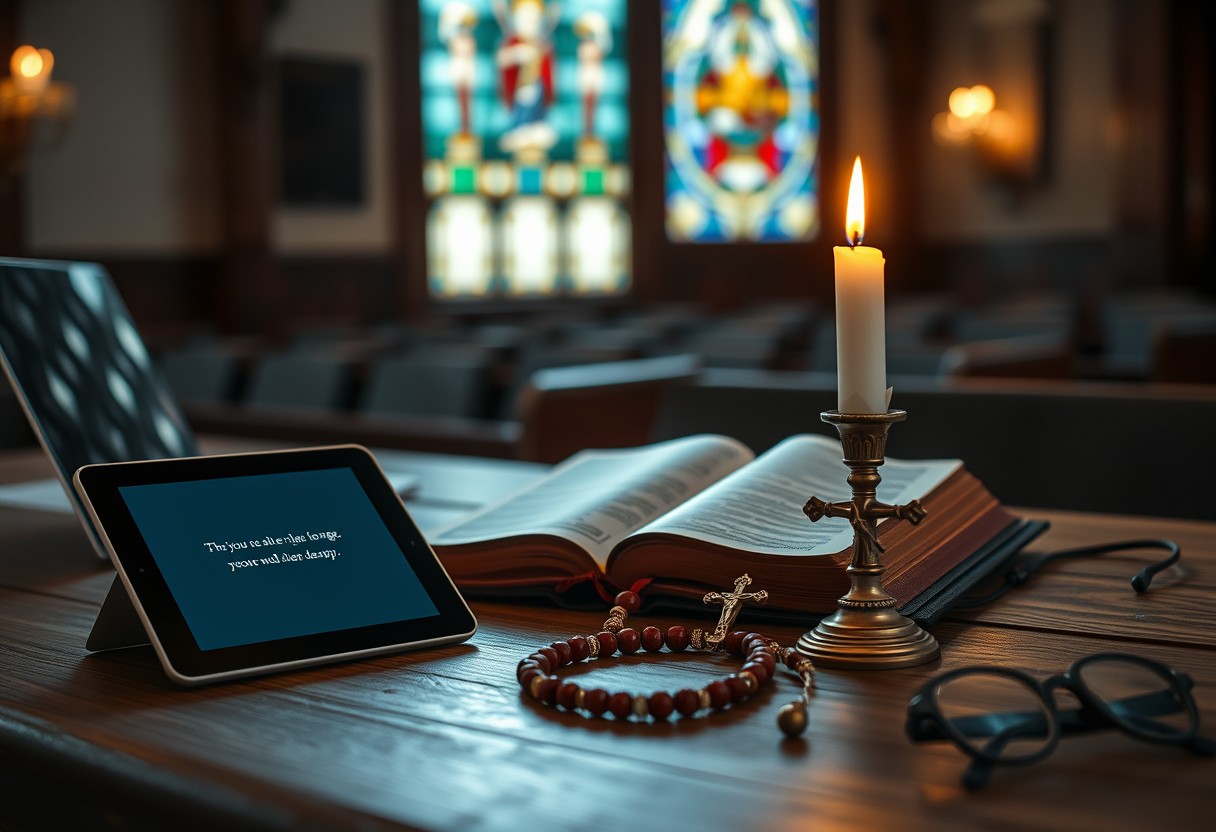
Catholics can now access AI tools that assist in prayer and Bible study, offering real-time reflections, language translation, and scriptural summaries. While these innovations provide immediate access to spiritual insights, they also carry the danger of reducing prayer to an automated routine. You are invited to consider how technology aligns with tradition, ensuring that authentic encounter with God remains at the heart of every practice.
Key Takeaways:
- A Catholic may use artificial intelligence as a tool for prayer and Bible study as long as the technology serves to deepen faith, does not replace sacramental life, and remains under the discernment of Church teaching.
- Historical precedents, such as the 8th-century “Iron Man” automaton attributed to Emperor Charlemagne’s court, show that mechanical aids in spiritual contexts are not entirely new, though modern AI raises distinct questions about authenticity and intentionality.
- Some dioceses have begun experimenting with AI-driven scripture reflection apps that generate daily meditations aligned with the liturgical calendar, such as a pilot program in the Archdiocese of Munich that uses natural language processing to summarize Church Fathers’ homilies for lay readers.
The Iron Monk and the Electronic Prayer
You interact with technology in ways that would have seemed unimaginable a generation ago, and prayer is no exception. Monastic communities have long valued repetition, silence, and discipline-qualities that align in unexpected ways with machine behavior. A 13th-century Franciscan friar, Ramon Llull, once designed intricate mechanical wheels of logic to derive divine truths, an early fusion of computation and contemplation. Today, some Catholics use AI-driven apps to generate personalized daily meditations rooted in the Liturgy of the Hours. While the machine cannot pray, it can structure time, prompt reflection, and deliver scripture in context-serving not as a replacement for faith, but as a disciplined assistant in spiritual formation. A modern user might receive a morning prompt combining Augustine’s sermons with real-time liturgical readings, all curated without human editorial delay. This integration mirrors the monastic ideal of ordered devotion, now enhanced through code. You are not outsourcing prayer-you are organizing it with tools that reflect your time, just as monks once shaped their spiritual lives around candlelight and chant. The danger lies not in the circuit, but in mistaking efficiency for intimacy. When the algorithm suggests a psalm that speaks directly to your grief, it feels like providence-yet you must remember the system responds to input, not intercession. The illusion of spiritual personalization can quietly erode the mystery necessary to faith. Still, when used with discernment, the electronic aid can echo the monastic bell-calling you back to stillness, not replacing it. A Benedictine oblate in Belgium, for instance, uses an AI script to randomize daily lectio divina passages, introducing holy unpredictability into routine study. The machine does not believe, but it can help you return, again and again, to the threshold of belief.
Searching the Word with a Binary Lantern
You can now access centuries of biblical scholarship through AI-powered search tools that locate scriptural references, cross-references, and theological themes in seconds. A single query might retrieve every Church-approved commentary on the Book of Job or compile all magisterial statements on mercy in modern encyclicals. What once required days in a theological library now unfolds in moments, though the risk of mistaking speed for depth remains real. You must still discern whether the algorithm prioritizes doctrinal accuracy or popular interpretations. Some apps trained on Protestant or secular datasets may omit Catholic nuances, such as the deuterocanonical books’ significance or the role of Sacred Tradition. You are not passive in this process; your engagement shapes how the tool serves your prayer. When used with intention, AI becomes a lantern-illuminating paths through Scripture but never replacing the light of faith. A mid-sized SaaS firm offering Bible study software recently reported that over 40% of its Catholic users consult footnotes and catechism links more than algorithmic summaries, suggesting a healthy caution. The most effective users treat AI as a starting point, not an endpoint.
The Altar and the Algorithm
You engage with sacred tradition not by rejecting tools, but by discerning their use. When an AI suggests a meditation on Psalm 23 during morning prayer, the value lies not in the machine, but in your response to the Word. A Jesuit in California uses a custom script to highlight thematic links between daily Mass readings and social justice writings, deepening reflection without replacing silence. What matters is whether the algorithm directs you toward reverence, not efficiency. You remain responsible for the spiritual intention behind every prompt you enter.
Conclusion
You engage with artificial intelligence not as a substitute for spiritual practice but as a tool that can illuminate scripture and structure reflection when used discerningly. A Catholic approach integrates technology without surrendering to it, ensuring prayer remains rooted in tradition, community, and grace. AI may parse biblical languages or suggest meditations, yet the heart of your prayer still beats in silence, sacrament, and personal encounter with the divine.
FAQ
Q: Is it morally permissible for Catholics to use AI tools when studying the Bible?
A: The Catholic Church has not issued a specific condemnation of artificial intelligence in spiritual practices, meaning its use in Bible study falls under general moral principles rather than a defined prohibition. Catholics may use AI to summarize passages, provide historical context, or translate scripture, as long as the tool serves as an aid rather than a replacement for personal engagement with the text. For example, a student preparing for a Bible study group might use an AI assistant to clarify the meaning of a difficult passage in Romans, but should still consult Church-approved commentaries and the Catechism to ensure doctrinal accuracy. The key concern is fidelity to Church teaching, not the technology itself.
Q: Can AI be used to generate prayers for personal or communal use?
A: While AI can produce grammatically correct and thematically appropriate prayers, these compositions lack the interior disposition that prayer requires. Prayer is a relational act between a person and God, involving intention, emotion, and spiritual presence-elements no machine can replicate. A layperson might use AI to draft a prayer structure before Mass, but must personally revise and internalize it to make it authentic. The Church emphasizes that prayer must arise from the heart; thus, AI-generated texts can only function as starting points, not finished spiritual acts.
Q: Does the Vatican have an official position on AI in religious life?
A: In 2023, the Dicastery for Culture and Education co-signed a statement called the “Rome Call for AI Ethics,” affirming that technology should serve human dignity and the common good. While not a doctrinal document, it signals the Church’s interest in guiding technological development through ethical and spiritual principles. The statement encourages transparency, accountability, and respect for human autonomy-values that apply when using AI in prayer or study. A diocese in Italy later used these guidelines to evaluate a proposed AI confessional app, ultimately rejecting it due to concerns about sacramental validity and privacy.
Q: Could AI ever replace spiritual directors or priests in guiding someone’s prayer life?
A: No, because spiritual direction involves discernment of spirits, sacramental authority, and personal accompaniment-functions rooted in human experience and ordained ministry. AI lacks the capacity for grace-filled judgment and cannot administer the sacraments. A young seminarian might use an AI tool to organize his daily examen, but the insights gained during confession with a priest cannot be replicated by an algorithm. The Church teaches that spiritual growth occurs through relationship, not information processing, making human guidance irreplaceable.
Q: Are there risks in relying on AI for theological interpretation?
A: Yes, because AI models are trained on vast datasets that include heterodox, heretical, or secular interpretations of scripture. An AI might, for instance, present a Gnostic reading of the Gospel of John alongside the Church’s traditional exegesis without distinguishing between them. A Catholic using such a tool without theological formation could unknowingly adopt erroneous beliefs. The Catechism remains the definitive guide for interpretation, and AI should only be used with critical oversight, much like one would vet any secondary source. A parish Bible study leader once cited an AI-generated explanation of the Eucharist that contradicted transubstantiation, prompting a corrective session with the local priest.
[…] For a related faith question, read Can Catholics Use Artificial Intelligence for Prayer and Bible Study?. […]
[…] For a fuller discussion, read Can Catholics Use Artificial Intelligence for Prayer and Bible Study?. […]