
The Washington, D.C.-based Institute on Religion and Democracy (IRD) launched its “Christians for Capitalism” project on June 2, seeking to bring together Christians of various traditions who support free-market capitalism.
“There was concern among a number of Christians in D.C. in the field of economics that there was no ongoing institutional voice in Washington, D.C., for pro-free market Christians, and there are obviously many Christians in D.C. who are pro-free market,” IRD President Mark Tooley told EWTN News.
“There was a vacuum here being filled by other voices and other perspectives that are critical of — if not hostile to — the free-market perspective,” he said.
Tooley, who is Methodist, said IRD is “not tied to any particular Christian tradition” and includes both Protestants and Catholics, noting “Catholics were among our founders.” He said IRD has been ecumenical from the start, with a focus on Christianity in the U.S., democracy, and human rights.
The IRD was founded in 1981, and most of its early board members were Protestant but also included one Catholic, the philosopher Michael Novak. Another early board member, Father Richard John Neuhaus, was Lutheran at the time but converted to Catholicism in 1990 and was ordained to the priesthood.
Tooley said the plan for the project is to hold events, publish articles, and host a semester-long fellowship for young people who align with their vision. He said he expects Novak’s writings to be prominently featured in the reading materials for the fellowship, which would likely meet twice per month this fall.
The launch event
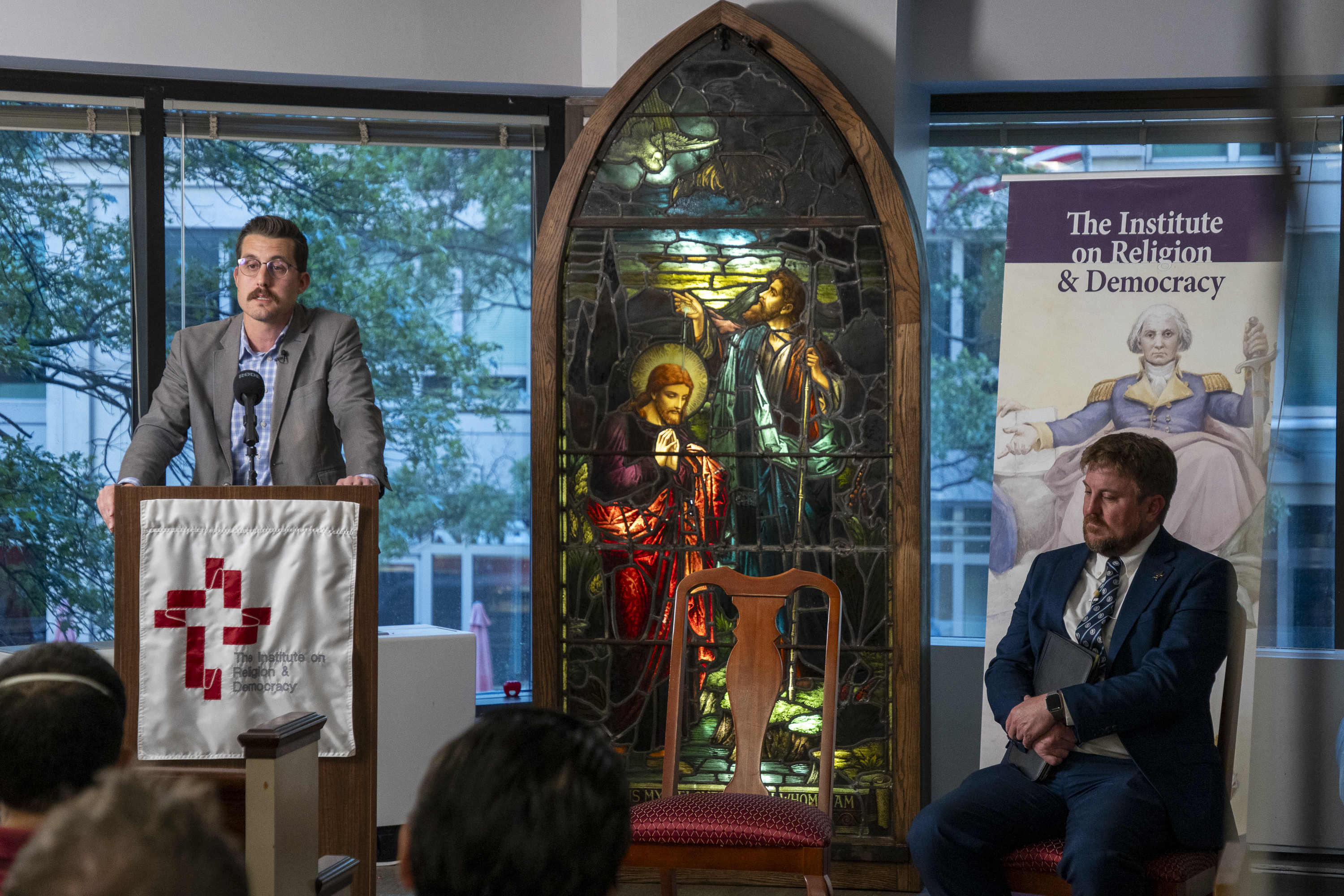
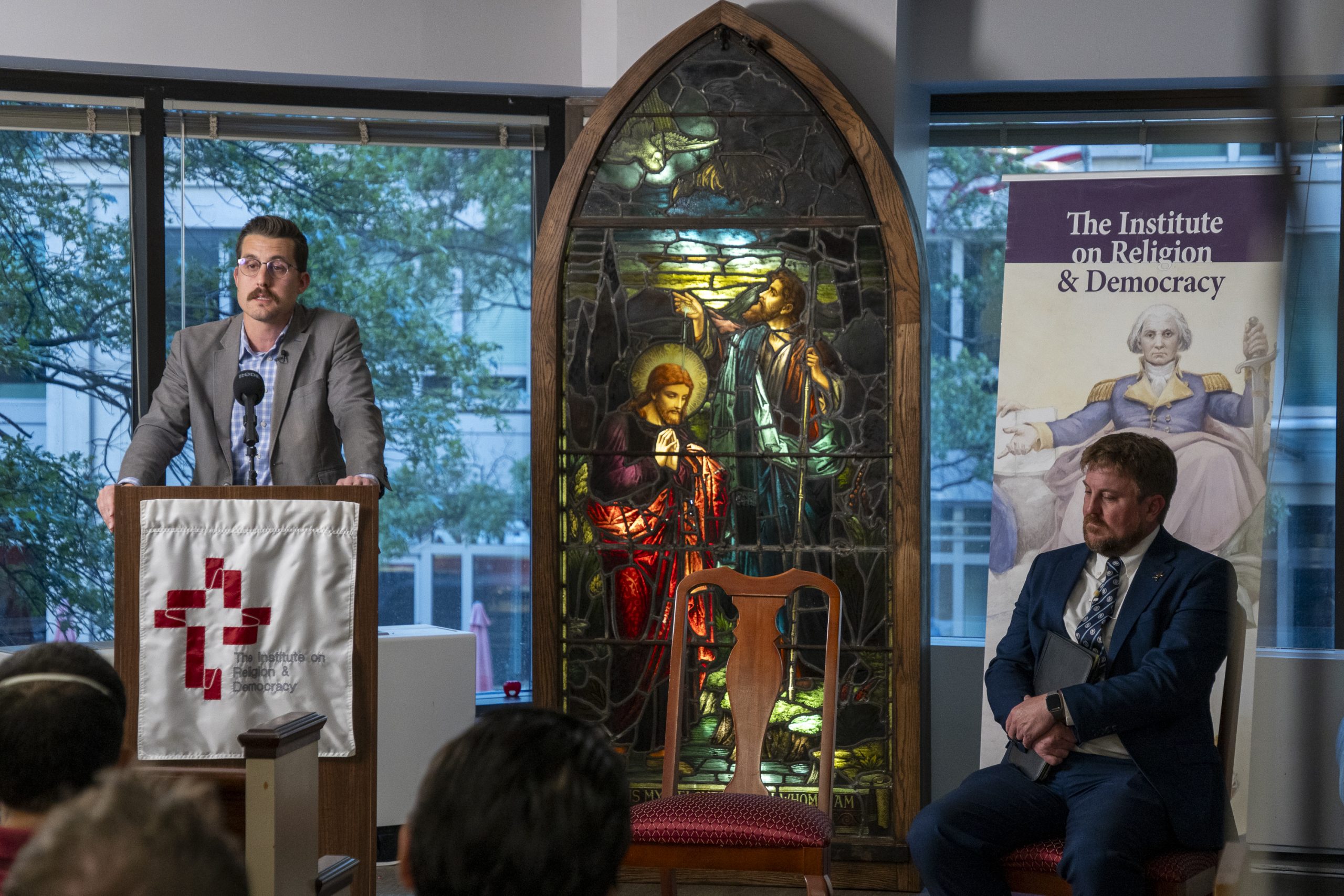
The IRD kicked off the initiative with an early evening event on June 2 at its headquarters in downtown Washington, D.C., just a few blocks north of the White House. A few dozen people gathered for the occasion, which included drinks, hors dʼoeuvres, and an hourlong presentation by two Christian scholars discussing the intersection of Christianity and economic thought.
Erik Matson, a Gibbons fellow in economics at The Catholic University of America, and Jordan J. Ballor, executive director of The Center for Religion, Culture, and Democracy at the First Liberty Institute — both of whom are Protestant — delivered the presentation on their book: “A History of Christian Political Economy.”
The book delves into economic thought in the Bible, among the early Church fathers, from medieval theologians, in the writings of later Protestant reformers and Catholic thinkers, and from contemporary scholars.
Jordan said during the presentation that theological perspectives are “not in the mainstream of what is taught in economics” but said “we might be missing something” when we fail to include theological perspectives in economic discourse.
Although much of the older writings do not touch on the subject in the form of an economic treatise, Matson explained in his presentation that Christians were “wrestling with political and economic issues” of the time and commenting on questions about wealth, poverty, and access to resources.
Matson identified two “broad competing perspectives” among the thinkers. One, he called “a limited good perspective” and the other, “a mutual benefits perspective.”
He said the first views material wealth as essentially “fixed,” in the sense that any transaction is “zero sum,” or “the gain of one is the loss of another.” The second views wealth as something that can increase into the future, in the sense that “the good of one need not come at the cost of the good of many” and that transactions can be “wealth generative” rather than just being shifts in resources.
According to Matson, “you can find both of these perspectives” over the course of the last two millennia within all Christian faith traditions. He pointed to St. John Chrysostom as falling more into the “limited good perspective” of economic thought and St. Thomas Aquinas as being more closely aligned with the “mutual benefits perspective,” for example.
Matson told EWTN News after the presentation “there’s no real discernible difference across denominations,” saying the research found representatives of both perspectives in Catholic, Protestant, and Orthodox thought.
He said Pope Leo XIII, who authored Rerum Novarum in 1891 and set the foundation of Catholic social teaching, is more “in line with [the] mutual benefits” understanding of economics. He said the pontiff understood the importance of property but also saw “a role for the government [and] for voluntary associations [and] trade associations.”
The book also touches on more direct contributions Christian thinkers made to economics, such as the the School of Salamanca, which was a Catholic Scholastic movement that developed the quantity theory of money and dealt with questions such as pricing and usury.