
He joined the Franciscan Order of Friars Minor in 1243. At the University of Paris, he studied under the renowned Franciscan theologian Alexander de Hales; in 1257 he earned his teaching license (magister cathedratus) in theology there. Bonaventure was a contemporary of St. Thomas Aquinas, whom he met as they were both teaching at the university. The two future doctors of the Church were united in defending the then-nascent Franciscan and Dominican orders, whose orthodoxy was called into question by the secular clergy.
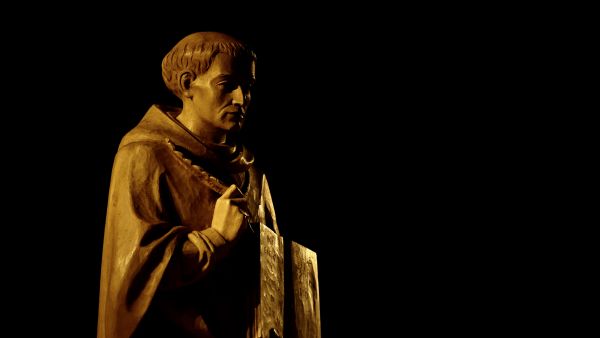
Bonaventure’s teaching career was cut short; in 1257 when he was appointed minister general of the Franciscan order, which was then plagued by internal factionalism due to divergent understandings of Francis’ spirituality following his death.
To rectify this, Bonaventure spent much time traveling around Europe to help maintain the unity of the order. In 1260 went to Narbonne, France, to solidify the rule of the order and that same year he started writing (which was completed three years later in 1263) the Legenda Maior, “The Major Legend,” considered the definitive biography of St. Francis. For Bonaventure, the key to righting the order lie in Francis’ ideals of obedience, chastity, and poverty, which he re-established as the Franciscans’ guiding principles.
Enduring influence
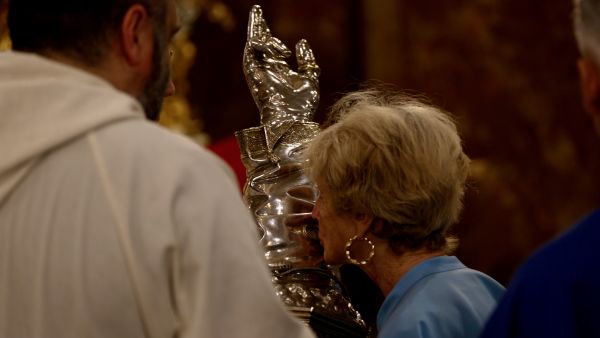
In addition to his contributions as the “second founder” of the Franciscans, Bonaventure had a profound impact on the papacy. Following the chaos of the three-year conclave in Viterbo that elected Gregory X in 1271 (the longest papal election in the history of the Church), the new pontiff, also a Franciscan, entrusted Bonaventure with preparing many of the key documents for the Second Council of Lyon (1272-1274) which sought to unify the Latin and Greek Churches.
He was made a cardinal in the consistory of May 28, 1273. He did not, however, see the end of the council, as he died on July 15, 1274. He was canonized in 1482 by Pope Sixtus IV and proclaimed Doctor of the Church by Pope Sixtus V in 1588.
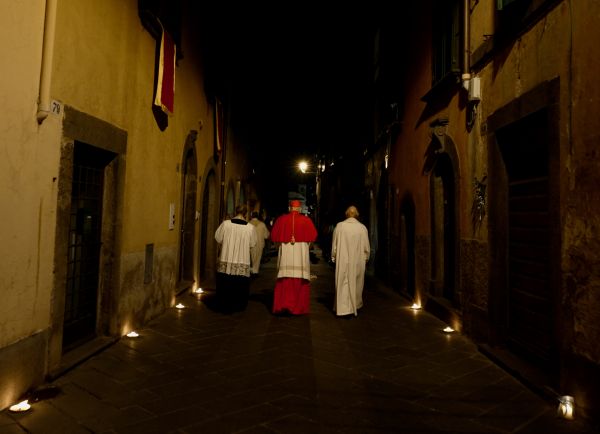
In 2009, Pope Benedict XVI, who was a great admirer of Bonaventure, visited the saint’s birthplace to venerate the relic and address the faithful. In 2010 he dedicated three consecutive Wednesday audiences on the saint, outlining the importance of his governance of the Franciscans and his theological, philosophical, and mystical works. Bonaventure’s writings, Benedict observed, demonstrate that “Christ’s works do not go backwards, they do not fail but progress.”
“For St. Bonaventure, Christ was no longer the end of history, as he was for the Fathers of the Church, but rather its center; history does not end with Christ but begins a new period,” Benedict said.
(Story continues below)
“The following is another consequence: Until that moment the idea that the Fathers of the Church were the absolute summit of theology predominated, all successive generations could only be their disciples,” Pope Benedict explained.
“St. Bonaventure also recognized the Fathers as teachers forever, but the phenomenon of St. Francis assured him that the riches of Christ’s word are inexhaustible and that new light could also appear to the new generations,” he said. “The oneness of Christ also guarantees newness and renewal in all the periods of history.”

Matthew Santucci has recently started in EWTN’s Vatican bureau. He grew up in Connecticut and has been living in Rome since 2020. He has a B.A. in History from Fordham and an M.A. in International Relations from Luiss Guido Carli.