
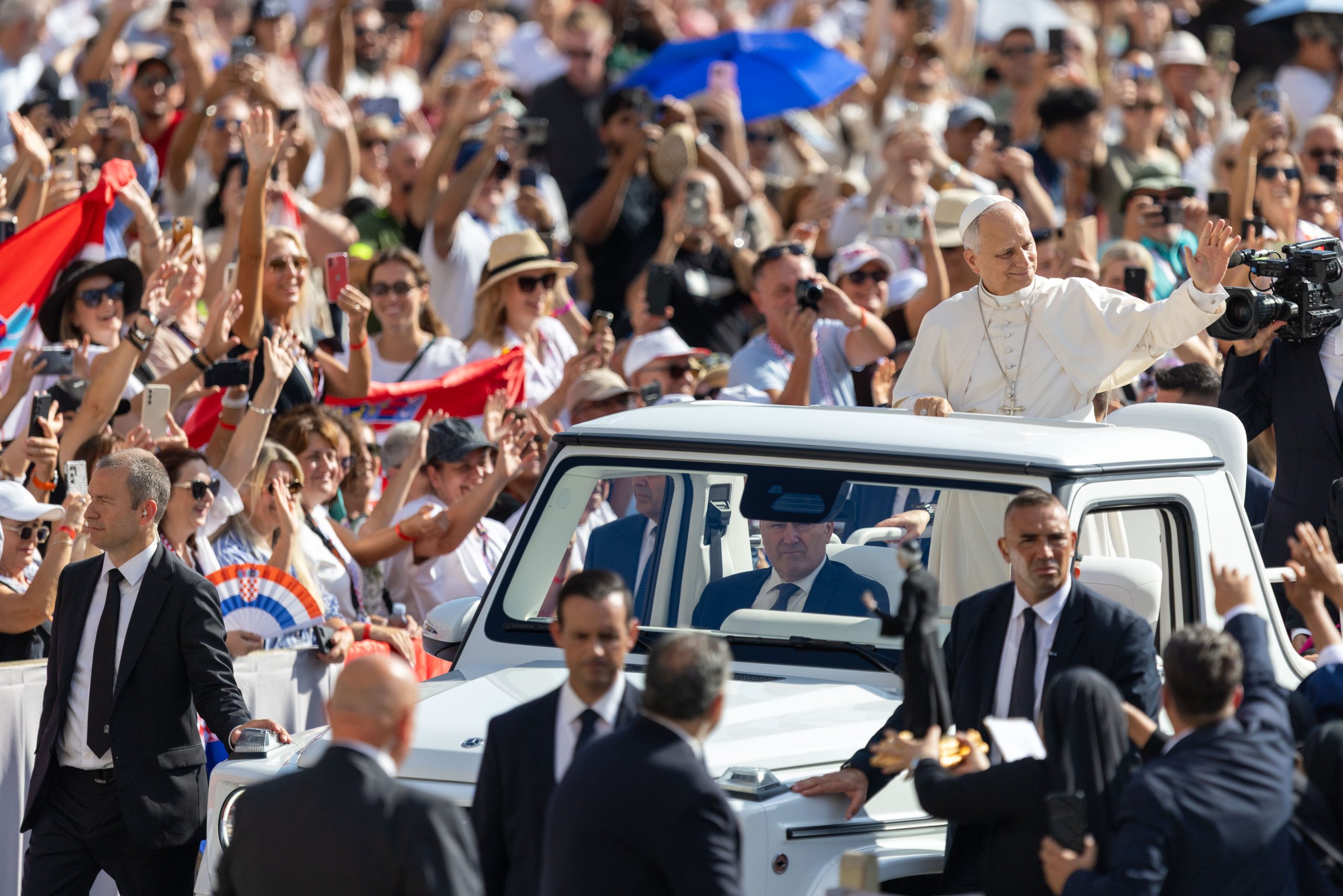
VATICAN CITY — Pope Leo XIV at his Wednesday general audience urged people to take responsibility for the dignity of each human person and to embrace an identity centered on gift of self.
“This dignity is entrusted to the responsibility of each person: at the same time, it also demands solidarity and mutual care, overcoming the many falsifications and manipulations that still disfigure our perception of it and hinder its realization,” the pontiff said on Sept. 9.
Addressing pilgrims in St. Peter’s Square, the pope continued his catechetical cycle dedicated to the Second Vatican Council’s constitution Gaudium et Spes, whose first chapter addresses the dignity of the human person.
In particular, the Church’s magisterial document underscores that human dignity is the foundation and condition for “those values which are most highly prized today,” while warning that these must not lose sight of their “divine source,” in order to avoid possible distortions arising from the “taint in man’s human heart.”
The pontiff noted that “the path ahead is not yet complete and must address the contradictions, both old and new, which prevent its full realization.”
He also recalled that the Church offers a clear contribution in this area by reaffirming that human dignity arises from the very being of the person, citing in this context his recent encyclical Magnifica Humanitas.
He explained that the infinite dignity of the human being is rooted in his identity as a creature made “‘to God’s image’ … capable of knowing and loving his Creator” and noted that “the person always implies relationship, communion, and participation in relation to God and to others.”
Struggle between good and evil
He also emphasized that the dignity of the person “excludes self-centered isolation. To be a person means to perceive oneself as a gift to be shared, growing and maturing through acceptance, reciprocity, and service.”
The Holy Father presented decisions contrary to human dignity throughout history as one of the causes of humanity’s “inner division.”
“All of human life, whether individual or collective, shows itself to be a dramatic struggle between good and evil, between light and darkness,” he said, quoting Gaudium et Spes.
He also called for overcoming “dualistic views” that separate the body from the soul, recalling that “human dignity concerns the whole person.”
The body is not an object
“Reducing the body to an ‘object’ to be disposed of arbitrarily is always a denial of the dignity of the person,” he said.
In this context, he recalled that “man is not allowed to despise his bodily life” and “is obliged to regard his body as good and honorable since God has created it and will raise it up on the last day,” while ensuring that it does not become enslaved by “the evil inclinations of his heart,” since all are wounded by sin.
According to the pope, “it is only in him that the mystery of the human person finds true light; from him we receive light on the enigma of suffering and death; and with him we journey towards the Resurrection.”
“Dear brothers and sisters, created in God’s image, through Christ and for his sake, we have received a unique and indelible dignity. Let us commit ourselves to promoting and defending it always, with the light and strength of the Gospel,” he concluded.
This story was first published by ACI Prensa, the Spanish-language sister service of EWTN News. It has been translated and adapted by EWTN News English.