
Research reviewed October 2, 2026. Figures below retain their original reporting periods.
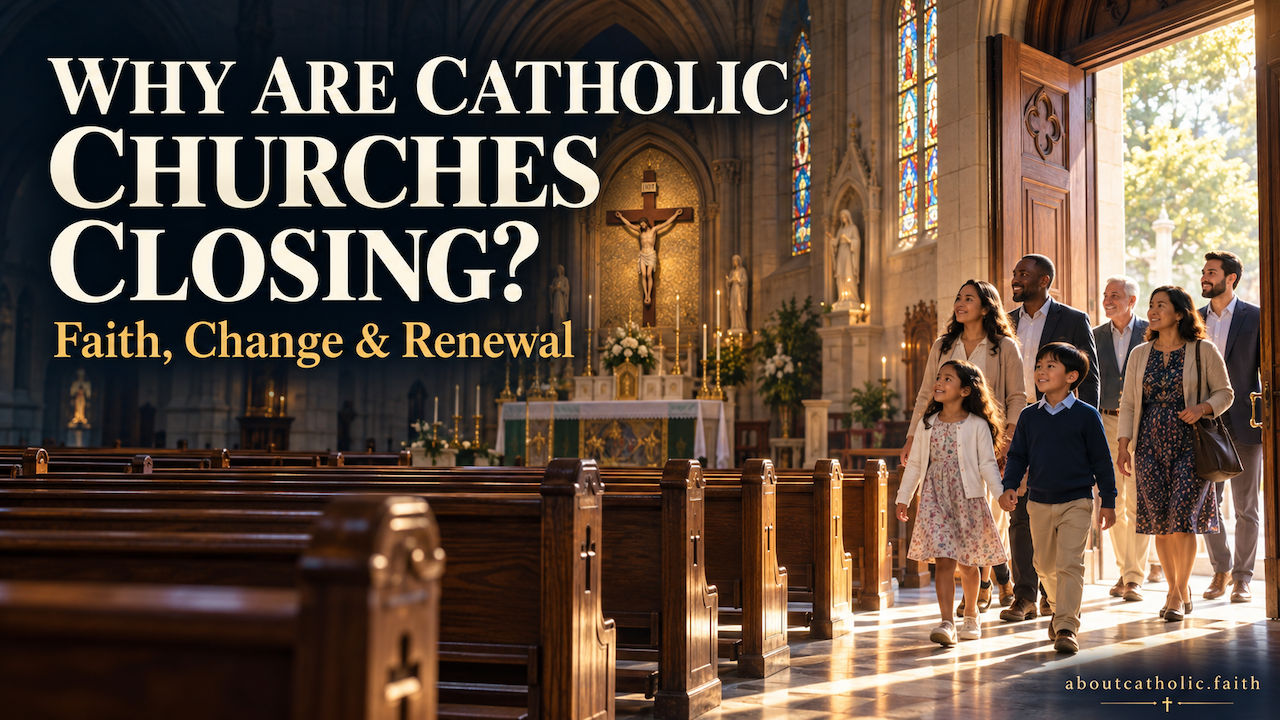
When a Catholic church closes, the loss is deeply personal. Families remember the font where their children were baptized, the aisle where they exchanged vows, and the place where they prayed beside a loved one’s coffin.
A diocesan announcement may describe a merger or a realignment. Parishioners may hear something much harder: the spiritual home that held their family’s story is changing.
Yet a complete account of American Catholic life must also make room for recovering congregations, immigrant families sharing their faith, and communities preparing another generation for the sacraments.
Catholic churches close or merge for overlapping reasons: changes in population, fewer practicing parishioners in some places, limited priest availability, building costs, and pastoral planning decisions. National parish numbers have fallen, but that does not mean every Catholic community is shrinking or that every parish merger closes a church building.
Understanding the difference helps us ask a better question: How can the Church preserve access to Christ, the sacraments, and a community of faith while responding honestly to change?
Are Catholic parish numbers declining in the United States?
Yes. The Center for Applied Research in the Apostolate’s national statistics, drawing on sources including The Official Catholic Directory, show a substantial long-term reduction.
| Reporting year | U.S. Catholic parishes |
| 1990 | 19,620 |
| 2000 | 19,236 |
| 2010 | 17,958 |
| 2020 | 16,703 |
| 2021 | 16,579 |
| 2025 | 16,125 |
The 2020–2025 difference is 578 fewer parishes, a net decline of approximately 3.5%. Compared with 1990, the decline is approximately 17.8%.
These are net parish counts, not totals of buildings closed. CARA generally reports the situation at the beginning of the listed year.
A parish total measures the Church’s organization. Understanding what happened to individual communities requires examining local decisions.
What is the difference between a parish merger and a church closure?
A parish is a community with a formal place in the Church’s structure. A church is a sacred building. The two are connected, but they are not interchangeable.
Canon 515 of the Code of Canon Law describes a parish as a stable community of the faithful under a pastor and the diocesan bishop. It gives the diocesan bishop authority to establish, suppress, or substantially alter parishes, with the required consultation.
A merger can therefore bring several communities into one parish while retaining more than one worship location. A shared pastor does not automatically mean every parish has ceased to exist.
The permanent withdrawal of a church building from sacred use is a separate matter. Canon 1222 provides conditions for this, including circumstances involving an unusable building or other grave causes, and safeguards concerning the good of souls.
When reading a closure announcement, ask: Is the parish changing, is the building closing, or are both happening?
Why are Catholic churches closing or merging?
The population around a church can change
A building remains in the same place even when families move.
Baltimore provides a documented example. In his explanation of the Seek the City initiative, Archbishop William Lori described the city’s substantial population loss since the period when its dense parish network flourished.
The archdiocese’s published restructuring plan describes the former 61 parishes becoming 30 worship and ministry sites in Baltimore City and nearby suburbs.
Those categories matter: 61 parishes and 30 sites are not equivalent units. The example nevertheless shows why a city’s earlier pattern of Catholic institutions may no longer match its population or pastoral needs.
Priest availability affects pastoral planning
CARA’s national statistics list 35,513 total priests in 2020 and 33,462 in 2025. Its 2025 figures also identify 3,674 parishes without a resident priest pastor.
“Without a resident priest pastor” does not mean “without Mass” or “abandoned.” Priests may serve several communities. But staffing decisions affect travel, sacramental schedules, and the demands placed on clergy.
Numbers alone do not determine which parish should merge. They help explain why dioceses face difficult choices about how to provide pastoral care.
Buildings require money that communities may struggle to provide
Sacred places need roofs, heating, insurance, repairs, and accessibility improvements.
An official Diocese of Erie decree concerning St. Elizabeth Church in Corry illustrates how building costs, limited use, and pastoral considerations can combine in a particular decision.
That case should not be treated as an explanation for every closure. Each parish deserves an account of its own circumstances.
A responsible discussion asks both whether a building can be sustained and what its loss would mean for people who depend on it.
Some Catholics have lost belief or trust
Institutional change is also a spiritual and relational story.
In Pew Research Center’s 2025 research on why people leave Catholicism, former Catholics identified several major reasons: no longer believing the teachings, scandals involving religious leaders, and dissatisfaction with teachings on social and political issues.
These are respondents’ explanations for leaving their religion, not a formula explaining every parish closure.
Still, the findings make one point unavoidable: administrative restructuring cannot by itself repair broken trust or answer unresolved questions about faith.
Catholic renewal requires credible safeguarding, accountability, patient teaching, and genuine opportunities to be heard. People should be able to ask difficult questions without being treated as problems to manage.
What has happened to Catholic Mass attendance over the past five years?
The recent story includes a severe pandemic disruption and evidence of recovery. It does not support a simple claim that attendance has fallen continuously everywhere.
CARA’s February 2025 analysis reported these estimates:
| Period | Estimated average weekly Mass attendance |
| 2019, before the pandemic | 24.4% |
| March 2020–May 2023 | 15.0% |
| May 2023–early January 2025 | 24.0% |
CARA used national surveys and Google search trends to model attendance. These are estimates, not a nationwide count of people entering churches.
The periods are also unequal. The 15% figure is not a separate result for 2021, 2022, or 2023. This article does not present an invented annual national series for 2021–2025.
The defensible conclusion is that CARA’s estimates showed recovery to approximately the pre-pandemic level by early 2025. Recovery from COVID does not establish a reversal of decades of declining participation.
Gallup’s pooled 2021–2023 surveys found 33% of Catholics attending weekly or nearly weekly, compared with 45% in 2000–2003. Pew’s 2023–2024 Religious Landscape Study found 29% attending at least weekly.
These are different measures collected through different methods. They should not be joined into a single trend line.
A five-year local example: Cincinnati
The Archdiocese of Cincinnati’s published 2025 statistical charts provide a consistent local sequence:
| Year | Reported weekend Mass attendance |
| 2021 | 99,909 |
| 2022 | 106,604 |
| 2023 | 111,432 |
| 2024 | 113,740 |
| 2025 | 118,939 |
Attendance increased approximately 19% between 2021 and 2025. It remained roughly 9% below the 2019 figure of 131,262.
This is evidence about one archdiocese. It demonstrates how recovery can be real while a community still faces a gap from its earlier attendance.
Is the Catholic Church shrinking or changing?
Both descriptions can be true, depending on what is being measured.
Pew’s 2023–2024 Religious Landscape Study found Catholics represented 19% of U.S. adults. Its broader analysis describes relative stability in the Catholic share in recent years, following earlier decline.
That does not mean parish numbers or weekly participation are equally stable. Identifying as Catholic, attending Mass, registering with a parish, and preparing a child for a sacrament are different things.
A CARA study published in 2023 also helps explain the apparent contradiction. Its national comparison found fewer parishes but a larger reported Catholic population between 1970 and 2020. The study’s detailed analysis covered 11 dioceses selected for the commissioning organization, FutureChurch; those dioceses were not a nationally representative sample.
The analytical lesson is straightforward: a Church can have fewer administrative communities while serving more people per parish. That possibility does not erase local losses, and it does not tell us whether individuals are becoming more committed disciples.
How immigrant Catholics are helping sustain American parish life
Any serious account of Catholicism in America must recognize immigrants as participants in its story, not as an afterthought.
According to Pew’s demographic profile of U.S. Catholics, 29% of Catholic adults are immigrants and another 14% are children of immigrants. Together, that is 43%.
The same profile reports that Hispanic Catholics make up 36% of Catholic adults, up from 29% in 2007. It also documents the younger age profile of Hispanic and Asian Catholics compared with White Catholics.
These findings establish demographic significance. They do not prove that immigration caused a particular parish’s attendance recovery.
The spiritual contribution deserves attention in its own right: the faith people teach their children, the communities they form, the leadership they offer, and the devotional practices they share.
Vitality includes devotion, formation, and service
Pew’s study of Hispanic Catholic life found greater emphasis on Marian devotion and religious celebrations associated with ethnic or national heritage than among White Catholics.
It also found weekly attendance among Hispanic Catholics at 26%, comparable to the share among White Catholics. Hispanic identity and immigrant status are different categories.
We can celebrate a community’s gifts without declaring that one ethnicity is inherently more faithful than another. Nor should expressive worship be the only measure of vitality. Reverent silence, care for the sick, faithful catechesis, and sustained service also reveal a living faith.
A concrete example comes from the Archdiocese of Atlanta. In “Growing up in a eucharistic environment,” Father Tri Nguyen described the Vietnamese Eucharistic Youth Movement and its role in formation at Holy Vietnamese Martyrs and Our Lady of Vietnam parishes.
He recalled teenagers who stayed to pray near the tabernacle after their peers had left for recreation. Their devotion helped encourage his own discernment of the priesthood.
That is a different kind of evidence from a survey, but it reveals something an attendance total cannot: faith being received, practiced, and passed on.
The contribution also reaches the priesthood
The USCCB and CARA’s survey of the ordination class of 2026 found that 26% of responding ordinands were born outside the United States.
That figure concerns survey respondents preparing for ordination, not all American priests. It nevertheless shows another way the Church’s international character contributes to ministry in this country.
Welcoming immigrant Catholics means receiving fellow believers who may become teachers, parish leaders, religious, priests, and lifelong neighbors.
Belonging must go beyond an invitation
The U.S. bishops’ National Migration Week resources explicitly recognize America’s immigrant Church and encourage prayer, accompaniment, and solidarity.
For a parish, that invitation can become practical: understandable announcements, accessible sacramental preparation, relationships across language groups, and meaningful participation in parish decisions.
A family should not have to wonder whether its children belong, whether its devotional traditions are merely tolerated, or whether its members can serve in leadership.
Immigrant Catholics have dignity because they are persons loved by God. Their value never depends on whether they can rescue a parish budget or fill empty pews.
What parish closures can cost a community
The consequences deserve careful attention even when leaders believe a merger is necessary.
A new Mass schedule can create a transportation problem. A longer journey may be manageable for a healthy driver but difficult for an older parishioner. A larger combined congregation can offer more programs while making someone feel less personally known.
These are practical questions to investigate locally, not assumptions about every merger.
Before assessing a plan as successful, parish leaders and parishioners should ask:
- Can people still reach Mass and confession?
- Have homebound parishioners retained dependable pastoral contact?
- Can families obtain sacramental preparation in a language they understand?
- Are ministries serving the neighborhood continuing?
- Are newcomers and longtime members represented in decisions?
- Is there a clear explanation of finances, buildings, and the transition?
A balanced assessment listens both to those planning for the future and to those mourning what is being lost.
What should Catholics do when their parish may close?
Begin with the official diocesan announcement and any decree. Establish what is actually proposed, which decisions are final, and where questions should be directed.
The Archdiocese of Baltimore’s letters and decrees page illustrates why these documents matter: it distinguishes types of reorganization and provides information about seeking reconsideration.
Procedures and deadlines require attention to the specific decree and applicable canon law. Anyone considering formal recourse should promptly obtain qualified canonical guidance; an old deadline from another diocese is not a guide for a current case.
Alongside that process, ask where sacramental records will be kept, how existing ministries will continue, and what help is available for people who cannot easily travel.
If you join another parish, give yourself permission to grieve. Finding a new spiritual home does not require pretending the old one did not matter.
Receiving communities also have a responsibility. Learn people’s names. Invite their participation. Preserve meaningful memories where possible. Avoid treating displaced parishioners as an inconvenience.
What would genuine Catholic renewal look like?
A fuller church is encouraging. A balanced budget is necessary. Neither is a complete definition of Catholic renewal.
The Catechism, paragraph 1324, identifies the Eucharist as the “source and summit of the Christian life.” That gives pastoral planning its center: helping people encounter Christ and live the faith they celebrate.
From that perspective, useful signs to look for include sustained sacramental participation, trustworthy leadership, serious formation, vocations, care for vulnerable neighbors, and relationships that cross generational and cultural boundaries.
These are pastoral priorities, not a statistical formula guaranteed to reverse decline.
A merged parish may become stronger if people are accompanied through the transition. It may also lose people if the process leaves them unheard. Outcomes should be evaluated rather than assumed.
Catholic hope makes room for honest numbers and honest grief. It also makes room for the newcomer whose faith helps longtime parishioners rediscover the gift they share.
Frequently asked questions
Does a parish merger mean the church building will close?
Not necessarily. A parish reorganization and a decision about a church building are separate matters. Read the local decree to determine which worship locations remain available.
How many Catholic parishes are there in the United States?
CARA’s 2025 reporting column lists 16,125. That is a dated parish count, not a live total of Catholic church buildings.
Has Mass attendance recovered since COVID?
CARA’s estimates indicated a return to approximately pre-pandemic attendance by early 2025. Local recovery varies, and this does not establish that the longer-term decline has reversed.
Are immigrants renewing the Catholic Church in America?
Immigrant Catholics make up a substantial share of the Church and contribute to formation, ministry, and community life. Evidence supports recognizing those contributions; it does not justify saying every immigrant community is growing or that immigration alone prevents closures.
Does a church closure mean the faith has failed?
A closure shows that a particular community or building is undergoing a serious change. It deserves an honest explanation. It is not, by itself, a complete measure of the faith of the people who worshiped there.
When the doors of a beloved church close, the memories remain. The responsibility to care for one another remains too.
The future of Catholic life will be shaped in part by whether grieving parishioners, returning Catholics, young families, and newcomers from other countries are helped to recognize one another as members of the same Church.
What has helped your parish build that sense of belonging through change? Share your experience in the comments.
Publishing details
SEO title: Why Are Catholic Churches Closing? Decline & Renewal
Suggested slug: /why-catholic-churches-closing/
Meta description: Why are Catholic churches closing? Explore parish decline, Mass attendance trends, immigrant Catholic communities, and practical paths to renewal.
Primary search phrase: why are Catholic churches closing
Supporting phrases: Catholic parish closures; Catholic parish mergers; Catholic Mass attendance statistics; decline in Catholic parishes; immigrant Catholics in America.
Suggested excerpt: Catholic parish closures tell only part of the story. Explore what research reveals about fewer parishes, recovering Mass attendance, and immigrant communities contributing to the Church’s future.
Editorial maintenance: Review numerical tables and source dates annually. Keep the evergreen URL, and update the research-review date only after substantive verification. Search phrases reflect editorial intent, not verified search volumes.