
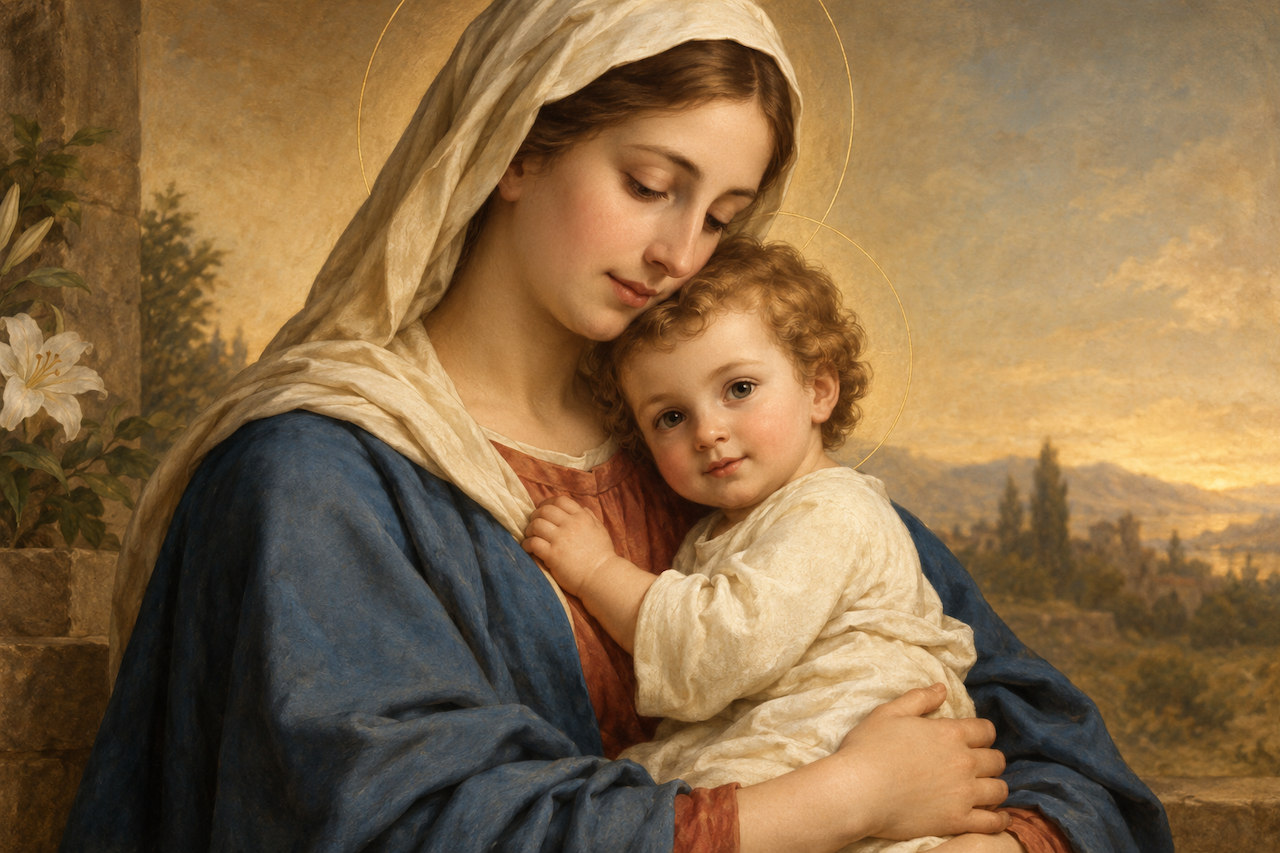
No. Catholics worship God alone. We honor Mary as the Mother of Jesus and ask for her prayers, but the Church distinguishes this veneration from the adoration owed to the Father, Son, and Holy Spirit (CCC 971).
If you have watched Catholics kneel before a Marian statue or heard a church filled with Hail Marys, the question is understandable. A practice that feels familiar to one Christian can look troubling to another.
It deserves a clear answer, offered without embarrassment or hostility. Authentic devotion to Mary helps us know and love Jesus.
Worship belongs to God
Catholic teaching recognizes an essential difference between worship and the honor given to a saint. God is our Creator and Savior. Every saint, including Mary, depends on his grace.
Mary receives particular honor because of her unique relationship to Jesus and her faithful response to God. She is a creature, never a fourth person of the Trinity. No Catholic devotion should treat her as a source of power independent of the Lord.
The Catechism explains that her maternal role depends entirely on Christ’s mediation (CCC 970). This is the foundation for understanding everything else Catholics say about her.
Why Catholics ask Mary to pray
Christians regularly ask one another for prayer. A friend may ask you to pray for a child, a marriage, or a difficult decision. You can agree without suggesting that Jesus is inaccessible.
Catholic prayer to Mary belongs to the Church’s understanding of the communion of saints: those who live with God remain united with us in Christ. Asking for Mary’s intercession means asking her to pray for us.
Catholics also pray directly to God. The Our Father, the prayer Jesus taught, stands at the heart of our prayer life. Mary does not have to persuade an unwilling Jesus to care about us. The love and mercy begin with God.
What about Jesus as the one mediator
First Timothy 2:5 identifies Jesus Christ as the one mediator between God and humanity. Catholics affirm this without qualification. Our reconciliation with God comes through him.
Earlier in the same chapter, Paul encourages intercessions for others (1 Timothy 2:1). The passage therefore does not present every act of intercessory prayer as a rival to Christ’s mediation.
Catholic teaching understands Mary’s intercession as dependent participation in his work. She does not add a second salvation alongside his. Her prayers, like every gift of grace, have their meaning through him.
Scripture helps explain our love for Mary
In Luke 1:26–38, Mary receives the angel’s announcement and freely responds to God’s call. Later, her song of praise directs attention toward the great things God has done for her (Luke 1:46–49).
At Cana, she notices a need and brings it to Jesus. She then directs the servants to follow his instructions (John 2:1–11). This is a helpful pattern for Marian devotion: bring the need to Christ and attend to what he asks.
Her faith also includes sorrow. A mother who stands near the Cross cannot be reduced to an image of an easy or sheltered life. Catholics who are grieving often find comfort in praying with her because she remained close to her Son in suffering.
What Mother of God means
Calling Mary “Mother of God” expresses a truth about Jesus. The one she bore is the eternal Son of God, truly divine and truly human. The title does not mean Mary created God or existed before him.
It protects the unity of Christ’s person. She did not give birth to a merely human individual who later became associated with God. Her Son is God made man. The Catechism explains this title in paragraph 495.
That is why Catholic teaching about Mary repeatedly brings us back to the identity of Jesus.
Understanding statues and the Hail Mary
A statue is an image, not a deity. Catholic teaching directs the honor shown through a sacred image toward the person represented, rather than treating the material object as divine (CCC 2132). External gestures need to be understood in that context.
The Hail Mary likewise has a particular meaning. Its opening draws on the angel’s greeting and Elizabeth’s words in Luke 1. Its second part asks Mary to pray for us now and at the hour of death. It does not ask her to replace God.
If Marian prayer is new to you, read those passages before praying. Understanding the words makes the practice less mysterious and more attentive to Scripture.
Questions about Catholic devotion to Mary
Can I pray directly to Jesus
Yes. Catholics should pray directly to Jesus and to the Father through him, in the Holy Spirit. Asking for Mary’s prayers supports that relationship.
Is Mary equal to God
No. Mary is a human person who has received extraordinary grace from God. She is entirely dependent on him.
Must every Catholic pray the Rosary every day
No. The daily Rosary is a valued devotion, not a universal daily obligation for every Catholic. Catholics can grow in prayer through several sound forms of devotion.
If someone asks why you love Mary, you can begin simply: “She is the mother of Jesus. I honor her, and I ask her to pray for me.” That answer leaves room for a respectful conversation about the Son who is at the center of her life.