

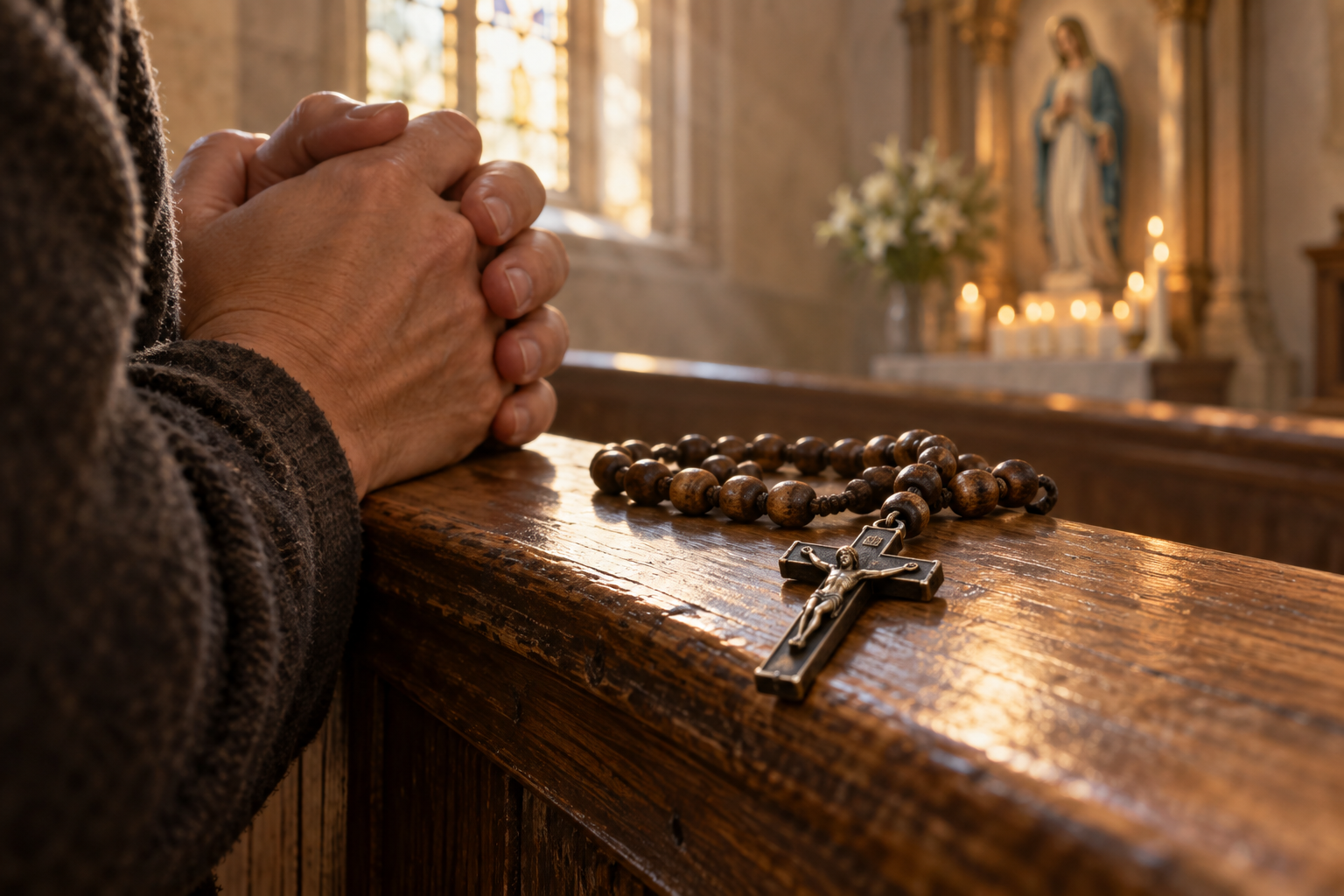
You have prayed for someone you love. You have named the same intention for weeks, perhaps years. The beads have passed through your fingers, but the conversation is still painful, the uncertainty remains, and you wonder whether another Rosary could possibly matter.
Catholics pray the Rosary to contemplate Jesus Christ with Mary and bring their needs to God. Its value does not depend on receiving a particular outcome. Through this prayer, we ask for real help while learning to remain close to Christ in circumstances we cannot control.
That answer can be difficult to receive when you are hurting. Faith does not require you to pretend otherwise.
What the Rosary invites us to do
The Rosary is rooted in Scripture. Its mysteries lead us through the life, death, and Resurrection of Jesus, while its prayers give our attention a steady rhythm. The US bishops describe it as a Scripture-based prayer whose repetition supports contemplation.
Mary accompanies that attention to her Son. We ask for her intercession as we consider the events through which God has revealed his love.
You do not have to produce a profound insight with every Hail Mary. Some days, simply remembering the mystery and returning to it when your mind wanders is the prayer you can offer. A tired person can pray. A grieving person can pray. A person who feels very little can pray.
When an unanswered prayer hurts
The Catechism treats disappointment in prayer seriously. In its discussion of trust, it asks why we think our petitions have gone unheard and directs us toward the Father revealed by Jesus (CCC 2734–2741).
This does not mean every painful event comes with an explanation we can identify. Nor should we tell someone that a tragedy happened because they prayed badly or lacked faith. We cannot measure a person’s relationship with God by the outcome of a particular request.
In Gethsemane, Jesus brings his anguish to the Father and asks that the cup pass from him, while surrendering to the Father’s will (Luke 22:39–46). His prayer gives us permission to speak honestly. We can ask for relief without apologizing for wanting it.
Surrender may begin with a small admission: “Lord, I do not understand. Please help me remain with you.”
The Sorrowful Mysteries make room for grief
The Sorrowful Mysteries can be especially meaningful when life is heavy. Jesus prays in anguish, suffers violence, carries the Cross, and dies. Christian prayer remembers these realities rather than skipping directly to Easter morning.
While meditating on the Agony in the Garden, you might bring the fear you cannot explain to anyone else. During the Carrying of the Cross, you might name the responsibility that has become exhausting. At the Crucifixion, you can remain quietly with Christ without forcing yourself to find something uplifting to say.
These meditations need not turn suffering into something attractive. They help us bring suffering into our relationship with Jesus. The Resurrection then keeps our hope open beyond what we can presently see.
Begin with one decade
If five decades feel beyond your strength today, begin with one. Choose a mystery, read a short Gospel passage about it, and tell God what is on your heart. Pray an Our Father, ten Hail Marys, and a Glory Be while returning gently to that scene.
When a distraction arrives, you do not need to punish yourself or restart. Notice it and return. If the distraction is a real concern, briefly entrust that concern to God.
Try praying at a time that already belongs to your day: before leaving home, during a quiet break, or before bed. A simple, sustainable practice gives prayer somewhere to grow. You can gradually add decades when you are able.
Let prayer lead into the next faithful action
After praying, ask whether there is a concrete good you can do. Perhaps you need to make a difficult phone call, apologize, accept help, or speak with your parish priest. Sometimes the next step is to rest so that you can meet tomorrow’s responsibilities.
Prayer belongs alongside responsible action. Entrusting someone to God does not remove the need to care for them. Asking for reconciliation does not mean ignoring the truth about a damaged relationship.
The Rosary may help you notice that the person before you needs your patience today, even while the larger problem remains unresolved. Such love matters, though it may never look dramatic.
Questions about praying the Rosary
Does a Rosary novena guarantee an answer
No devotion obliges God to provide a particular result on a deadline. A novena is a sustained act of prayer and trust. Catholics can ask confidently while leaving the outcome with God.
Does prayer count if I feel nothing
Yes. Feelings can accompany prayer, but they are not its measure. Returning your attention to God, even with effort, is a real act of faith.
Is one decade worth praying
Yes. One decade is a meaningful way to begin or to pray when time and energy are limited. It is one part of the Rosary, and you can build from there.
Tonight, bring the intention you are tired of carrying. You do not need a new way to explain it. Begin with the first bead and let your prayer be honest.